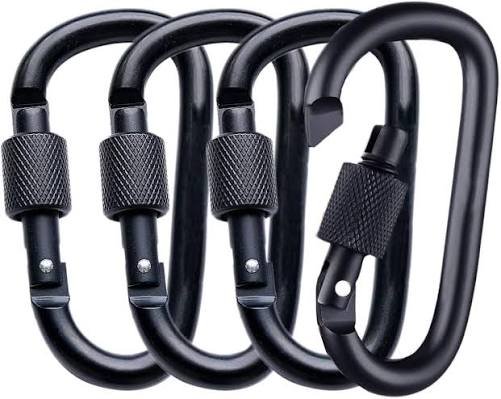
Choose a carabiner by matching three parameters to your application: shape (D or offset-D for anchors, HMS/pear for belay, oval for pulleys), gate (locking for life-safety connections, non-locking for quickdraws), and rating (look for a kN mark of 20+ on the major axis for human loads). Never use unrated accessory carabiners for any system supporting body weight.
Rated vs Accessory Carabiners — The One Decision That Matters Most
The single most consequential distinction in carabiner selection is whether the hardware is life-safety rated or manufactured as an accessory. A lot of the “how did this happen” stories you’ll read on rigging and climbing forums come down to somebody mistaking an accessory clip for a rated connection point.
A rated carabiner undergoes destructive testing to meet specific industrial or mountaineering standards, most notably CE EN 12275 or UIAA 121. These standards dictate a minimum breaking strength (MBS) that the unit must survive before mechanical failure. Accessory carabiners are extruded from low-grade aluminum, aren’t batch-tested, and are designed strictly for holding water bottles, keys, or dog leashes.
You can spot an accessory carabiner instantly by looking at the spine. No kilonewton (kN) marking, no CE certification stamp — not rated. A lot of manufacturers also stamp “NOT FOR CLIMBING” directly into the aluminum. And if the strength limit is listed in pounds instead of kilonewtons, that’s hardware-store gear, full stop.
| Feature | Rated Climbing Carabiner | Accessory Carabiner |
|---|---|---|
| Markings | kN ratings (3 axes), CE stamp, UIAA logo | “Not for climbing”, no ratings, or lbs limit |
| Minimum Strength | 20+ kN (major axis) | Unknown / untested (often fails under 2 kN) |
| Material | 7075-T6 Aluminum, Steel | Low-grade extruded aluminum |
| Typical Price | $7 to $35 | $1 to $5 |
| Allowed Uses | Climbing, hauling, rigging, belay | Keychains, water bottles, gear organization |
Decoding the Numbers Stamped on the Spine
The kN markings on a carabiner tell you the minimum breaking strength across three loading scenarios: gate-closed major axis, minor axis (cross-loaded), and gate open. Which of those numbers matters depends entirely on how you orient the hardware in the moment.
One kilonewton is roughly 224.8 pounds of force. A carabiner rated to 20 kN, then, will hold about 4,496 pounds of static force before it fails. The spine of a certified carabiner typically shows a string that looks something like this: ↔ 24 ↕ 8 ⤄ 8.
Major Axis (Gate Closed): The first number is the strength when loaded end-to-end along the longest axis with the gate fully closed. EN 12275 requires a minimum of 20 kN for standard D-shapes and 18 kN for ovals. Most modern climbing carabiners come in somewhere between 22 and 25 kN.
Minor Axis (Cross-Loaded): This is the cross-loaded strength, which is what you get when the carabiner rotates in a belay loop or anchor and force is applied against the gate and spine instead of the two strong vertical ends. Minor axis ratings are dramatically lower — typically 7 to 10 kN. CE minimum is 7 kN. That sounds like plenty until you remember a hard lead-climbing fall can generate 5 to 6 kN, which puts a cross-loaded carabiner uncomfortably close to failure. Not a comforting margin.
Gate Open: The final number is the major-axis strength with the gate held open. This is the scenario where the gate snags on the rock, or where “gate flutter” opens it momentarily during a fall. Minimums here are 7 kN for D-shapes and 6 kN for HMS/pear shapes.
You’ll also see letter designations stamped inside a circle on European gear:
- B (Base): Standard D or offset-D shapes.
- H (HMS): Pear shapes designed for belaying with a Munter hitch.
- K (Klettersteig): Via ferrata carabiners with specialized locking mechanisms and wide gate clearances.
Shape Determines Where the Load Goes
Carabiner geometry is really just an engineering trick to push force onto the strongest part of the frame — the solid spine, away from the gate. The shape you pick decides how the hardware behaves with different knots, ropes, and mechanical devices.
Oval: The original carabiner shape. Ovals distribute weight evenly between the two vertical axes. Because they don’t shift the load entirely onto the spine, they get away with the lowest major-axis strength minimum (18 kN). Their symmetry is also the reason they remain the only correct choice for use with mechanical pulleys, which tend to bind or tilt in an asymmetric carabiner.
D-Shape: The pure D-shape pushes the rope or sling away from the gate and directly against the solid spine. That geometry lets manufacturers hit higher strength ratings with less metal. D-shapes dominate industrial applications and heavy rigging.
Offset-D: Make the top basket of the D wider than the bottom and you get the offset-D. You keep the strength benefits of spine-loading and gain a much larger gate opening for clipping. The offset-D is the universal standard for sport quickdraws and traditional racking. The Petzl Sm’D — a compact offset-D at 46g — hits 23 kN precisely because of this load-shifting geometry.
HMS / Pear: HMS stands for Halbmastwurfsicherung, the German word for a Munter hitch, which tells you everything about who first popularized it. Pear-shaped carabiners have a narrow bottom that captures a belay loop and a wide top basket. The flat, wide top lets dual ropes, thick knots, or tube-style belay devices like an ATC sit cleanly without bunching against the spine. This is what you belay with. This is what you build a masterpoint with.
Gate Mechanisms — What Actually Opens and Closes
The gate mechanism decides how secure your connection is and how fast you can operate it. You’re always balancing the friction required to open the gate against the consequences of it opening when you don’t want it to.
Non-Locking Gates
Non-lockers use spring tension to snap shut. Built for speed and repetition. Quickdraws, racking gear.
- Straight Gate: A solid bar of forged aluminum. High durability, firm spring. Usually on the bolt-end of a quickdraw.
- Bent Gate: The solid bar has a concave curve. That bend cradles the rope and makes it easier to slap the rope through one-handed. Bent gates belong on the rope-end of a quickdraw and nowhere else.
- Wiregate: Instead of a solid block of aluminum, the gate is a continuous loop of stainless steel wire. Wiregates weigh significantly less — a CAMP Nano 22 comes in around 22-30g. Lower gate mass gives you a real mechanical advantage during severe falls. When the carabiner spine slams into the rock face during a fall, a solid gate has enough mass and momentum that it can whip open for a split second. That’s gate flutter, and in that split second your strength rating drops toward the gate-open number. Wiregates don’t have enough mass to flutter, so the carabiner keeps its full closed-gate strength through the impact. And because a wiregate doesn’t have an enclosed spring chamber, it won’t freeze shut in alpine conditions. Ice climbers figured this out a long time ago.
Locking Gates
A locker requires a deliberate secondary action to open. Life-critical links only.
- Screw-Lock: A threaded sleeve spins up the gate to lock against the nose. Most secure mechanical lock, provided you actually remember to screw it down. The Petzl Attache 3D uses a red security stripe that stays visible until the sleeve is fully locked — a quick visual check that has saved plenty of people from clipping in wrong.
- Twist-Lock / Auto-Lock: A spring-loaded sleeve rotates itself into a locked position when released. Twist 90 degrees and pull to open. Great for belaying because the gate secures itself, though the mechanism can jam with grit or mud.
- Triple-Action (Triact): Three movements to open (push up, twist, pull). Standard in professional rope access and industrial settings where accidental roll-out against structures is a real risk.
- Magnetic: Manufacturers like Black Diamond (Magnetron) use magnetic arms that pinch a steel insert in the nose. Speed of a non-locker, security of an auto-locker. Still fairly rare on the market.
The Keylock Nose vs Notched Nose Question Nobody Explains Well
The place where the gate meets the nose of the frame is one of the bigger quality differentiators in the whole product category, and most buyers never look at it.
Early carabiner designs required a mechanical hook — a notch — forged into the nose. A pin on the end of the gate would catch inside that notch, which is what gives the closed carabiner its major-axis strength. It works. It just also acts as a physical hook in every situation where you don’t want a hook.
When you try to unclip from a bolt hanger, or pull a wire-nut sling off your harness, the notch snags. Frustrating on a good day. On a bad day, if a bolt hanger ends up caught inside that notch and the climber falls, the carabiner is loaded entirely on the thin nose hook. Nose-hooking failures are ugly — the nose snaps well below 7 kN.
Modern mid-to-high-end carabiners use a Keylock nose. Petzl introduced the original Clean Nose on the Petzl Spirit (39g), replacing the hook-and-pin with a smooth interlocking geometry that slides cleanly out of hangers, webbing, and gear loops.
Expect to pay a premium of roughly $10 to $15 per unit for a standard non-locking keylock carabiner in the 2026 market. And because wiregates depend on the wire loop dropping over a notch, combining wiregate + keylock is mechanically awkward and usually requires either a secondary aluminum hood (Black Diamond HoodWire) or a proprietary forging (Wild Country Helium).
Matching the Carabiner to Your Actual Use Case
To avoid buying the wrong hardware, map your intended use against this matrix.
| Primary Use Case | Recommended Shape | Recommended Gate | Minimum Rating | Example Profile |
|---|---|---|---|---|
| Sport Quickdraws | Offset-D | Straight (bolt), Bent (rope) | 20+ kN | Solid gate, Keylock nose to avoid bolt snags. |
| Trad Racking | Small Offset-D | Wiregate | 20+ kN | Wiregate for absolute minimum weight. |
| Belaying | HMS / Pear | Screw or Auto-Lock | 20+ kN major | Wide top basket accommodates the belay device. |
| Anchor Masterpoint | Large Offset-D | Screw-Lock | 22+ kN major | High major-axis strength, secure screw sleeve. |
| Via Ferrata | Type K (Klettersteig) | Auto-Locking | EN 958 Certified | Wide opening, auto-locking, part of an energy absorber kit. |
| Hammock / Rigging | D or Offset-D | Wire or Straight | 20+ kN major | Aluminum frame, any non-locking gate. |
Via Ferrata Standard Requirements: Via ferrata puts massive static shock forces on gear if a climber falls vertically onto a fixed steel cable. Equipment has to meet EN 958 for energy absorbing systems. Use a Type K carabiner. Standard climbing carabiners aren’t designed for the impact profile of a via ferrata fall — the fall dynamics are just different.
The Hammock Exception: People rig hammocks with carabiners all the time, and there’s a common misconception that a cheap 500 lb (2.2 kN) accessory clip is fine because the user only weighs 200 lbs. That reasoning ignores suspension physics. As a hammock suspension angle approaches 0 degrees — that is, flat — the tension force on the hardware multiplies exponentially, and it climbs fast. Anybody who’s spent time on hammock rigging forums will tell you the same thing: use 20+ kN rated climbing carabiners for suspension connections. It’s the one place where the climbers and the hammock people fully agree.
Aluminum, Steel, or Something Else — Material Tradeoffs
The vast majority of climbing carabiners are forged from 7075-T6 aluminum alloy. Aerospace-grade, massive strength-to-weight ratio, and a standard aluminum offset-D lands somewhere between 40g and 80g. Aluminum is basically perfect for dynamic climbing. It’s not perfect for high-wear scenarios, and that’s where a lot of people get in trouble.
7075-T6 is rigid. It doesn’t have much elasticity, which means it deforms very little before it snaps outright under extreme torsional loading. Steel, by contrast, will bend and deform before it lets go, and that’s a meaningful difference when you’re loading hardware in ways it wasn’t quite designed for.
Steel carabiners are the answer for industrial wear. They’re heavy — 150g to 250g per unit is normal — but the durability against friction is in another league. When a dirty climbing rope runs through an aluminum carabiner, the silica and grit embedded in the nylon acts like sandpaper, and it carves deep, sharp grooves into the metal fast. Commercial climbing gyms use steel exclusively for fixed top-rope anchors, because an aluminum carabiner in that position gets sawed in half in six to twelve months. I’ve pulled anchors out of gyms with grooves you could seat a pencil in.
Hybrid designs try to split the difference. The Edelrid HMS Bulletproof runs a lightweight aluminum frame at 82g total, but places a stainless steel insert right at the apex of the basket where the rope actually runs, giving you the durability of steel where it matters and the weight of aluminum everywhere else.
How Long Does a Carabiner Last, and When Should You Retire It?
Nylon harnesses and dynamic ropes degrade under UV and have hard 10-year calendar lifespans. Metal hardware doesn’t. Petzl explicitly states that their metal products have an indefinite maximum lifespan, meaning a carabiner manufactured in 1995 could theoretically still be safe to climb on today, provided its condition is flawless.
Retirement is entirely condition-based. Inspect regularly and retire immediately if any of the following are true:
- Deep Rope Grooves: Rope friction wears down the basket over time. UIAA guidance is to retire once a rope groove exceeds 1mm in depth from the original surface profile. Past 1mm, the altered geometry can create sharp edges that will slice a rope under load.
- Sticky or Sluggish Gates: Hold a non-locking gate open and release it. It should snap shut instantly. If it doesn’t, clean it — hot soapy water, toothbrush, dry with compressed air, then a wax-based or Teflon-based lubricant like Metolius Cam Lube. If it’s still sluggish after cleaning, retire the unit.
- Visible Cracks or Corrosion: Any hairline fracture in the aluminum frame is an immediate retire. Severe corrosion (battery acid, extended saltwater submersion) also compromises the alloy. Flaking anodized paint is cosmetic and harmless. Pitting metal is fatal.
- Missing or Deformed Rivets: The small steel pin holding the gate to the frame has to be flush and secure. If it bends or loosens, the gate-closed rating is void.
- Significant Drops: The old rule is that if you drop a carabiner from height onto rock, you retire it because of invisible microfractures. Modern metallurgical testing rarely finds actual microfractures in dropped 7075-T6, but a drop from 50 feet onto granite can bend the frame microscopically enough that the gate pin no longer seats perfectly in the notch, and that’s what actually matters day-to-day.
If you retire a carabiner, wrap the gate in permanent tape or take a hacksaw to the frame. Don’t leave compromised gear lying around where someone who doesn’t know better will pick it up and clip into it.
FAQ
What does kN mean on a carabiner?
The kN marking stands for kilonewtons, a measure of force indicating the unit’s minimum breaking strength. One kilonewton equals approximately 224.8 pounds of force, so a carabiner rated to 20 kN can withstand roughly 4,496 pounds of static force before failing.
Are all carabiners safe for climbing?
No. Only life-safety rated carabiners stamped with a kN strength rating and a CE or UIAA certification mark are safe for climbing. Unrated accessory carabiners — the kind you’ll find in hardware stores or on keychains — will fail under body weight.
What’s the difference between a locking and non-locking carabiner?
A non-locking carabiner uses a spring-loaded gate designed for speed and repetition, which is what you want on quickdraws. A locking carabiner adds a mechanical sleeve (screw or auto-lock) that keeps the gate from opening accidentally. Belaying and anchor masterpoints both require lockers. There’s no middle ground on that one — if it’s holding a person on the ground end of the system, it locks.
When should I retire a carabiner?
Retire when a rope groove exceeds 1mm in depth, when the gate refuses to snap shut quickly even after cleaning and lubrication, or if you spot any visible cracks, sharp burrs, or severe chemical corrosion on the frame.