TL;DR
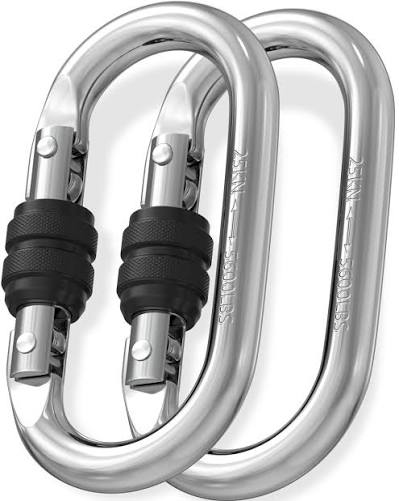
A carabiner transfers load along its solid metal spine while a spring-loaded, hinged gate lets you clip things in and out. Loaded correctly along its major axis with the gate closed, a standard climbing carabiner holds 20–25 kN (roughly 4,500–5,600 lbs). That number drops by more than half the moment the gate is open or the load goes sideways.
The Anatomy Behind the Clip (Not Just Parts on a Diagram)
Five primary components: spine, basket, nose, hinge, gate. Each one does a specific job under load. The spine is the structural backbone and takes almost all the force. The basket is the widened lower curve where ropes and slings settle, which keeps the load away from the weaker gate side.
Modern climbing carabiners are typically forged from 7075-T6 aluminum alloy, a zinc-blended aluminum with an exceptional strength-to-weight ratio, and manufacturers spend a lot of engineering effort machining the cross-section to squeeze every gram out of the frame without losing rated strength; the Petzl Ange, for example, runs an H-frame cross-section that gets total weight down to 31 grams while still hitting a 20 kN major axis rating, which is the kind of number that would have sounded absurd twenty years ago.
Industrial fall-protection carabiners usually go the other direction. Forged steel, heavier, but it takes a beating against cable and rigging plates in a way aluminum simply cannot.
How the Gate Actually Opens and Closes
The gate turns a closed metal loop into something you can actually use. In a standard solid-gate carabiner, the hinge houses a small internal compression spring. Push the gate open and an internal camming pin compresses that coil. Let go, the spring pushes back, gate snaps shut.
Wire-gate carabiners work on a different principle. The stainless steel wire itself is the spring. It’s a torsion spring rather than a compression one, tensioned at the hinge, twisting when you open it and springing back when you release. Same result, entirely different mechanism.
The closure interface between the gate and the nose also matters. Traditional carabiners use a notch in the nose that hooks onto a small pin in the gate. Holds high loads, but it snags on bolt hangers and Dyneema slings constantly during unclipping, which anyone who has climbed with an older rack has cursed about at least once. The modern keylock system removes the notch entirely and replaces it with a smooth, puzzle-piece profile on the nose that interlocks with the gate. No snags, faster clipping, and honestly there’s no good reason to buy a non-keylock biner in 2026 unless you specifically need the strength of a pin-and-notch design for something obscure.
Where the Load Actually Goes (Spine Physics 101)
When a carabiner is loaded, force travels through the spine, the solid curved backbone opposite the gate. The gate itself takes almost nothing structurally. It just closes the loop, keeps the frame from flattening outward under tension.
Shape dictates how efficiently that force reaches the spine. Symmetrical oval carabiners split the load evenly between the spine side and the gate side. The gate side is inherently weaker, so oval carabiners need more metal to hit safety minimums (UIAA minimum for oval major-axis strength is 18 kN). Asymmetric D-shaped carabiners get around this. The unequal basket shape physically forces the rope or sling to slide flush against the spine. Load goes where you want it, gate side does nothing, and you can hit 20 to 24 kN with significantly less material.
Which is why nobody uses ovals for anything except aid climbing and racking cams anymore.
Decoding the Three kN Ratings (And What They Really Mean in a Fall)
Every certified climbing carabiner has three kilonewton (kN) ratings etched into its spine, indicating minimum breaking strengths under the EN 12275 and UIAA 121 standards. One kilonewton is about 225 pounds of force (lbf).
The three ratings:
- Major Axis Closed (↕): Typically 20–25 kN (4,500–5,600 lbf). End-to-end loading along the spine.
- Minor Axis (↔): 7–9 kN (1,570–2,020 lbf). Cross-loading, force pulling directly against gate and spine.
- Gate Open (C) is usually 7–9 kN (1,570–2,020 lbf) and represents major axis loading with the gate unhooked from the nose, which is the failure mode that ruins most climbers’ day when it happens.
These numbers matter because falls generate real force. A factor 1 lead fall (say, 3.6 meters of drop with 3.6 meters of dynamic rope in the system) with an 80kg mass generates roughly 8.6 kN of impact on the top piece. A 24 kN major-axis rating gives a huge safety margin against that. That same 8.6 kN will happily snap a cross-loaded or open-gate biner.
Why Carabiners Fail — Cross-Loading, Nose-Hooking, and Gate Flutter
Climbing carabiners almost never fail from pure weight. They fail because the load shifts into an orientation the frame wasn’t built for.
1. Nose-Hooking
Nose-hooking is when the carabiner’s nose catches on a bolt hanger or wire nut instead of the metal loop seating fully into the basket. In this position the basket acts as a cantilever, which is exactly the geometry you don’t want. Black Diamond’s QC Lab tested nose-hooked carabiners and found they fail at under 2 kN, less than 450 lbf, which is less than 10% of the rated closed-gate strength. A moderate bounce test can break a nose-hooked biner. This is the one that scares me most because it’s the failure mode you’re least likely to notice before you weight the piece.
2. Cross-Loading
Cross-loading forces the carabiner sideways, pulling the gate away from the spine. With the minor axis rated at only 7 kN, the frame can absolutely snap during a moderate lead fall. Belay biners rotate during use, which is why so many now have captive-eye designs or plastic inserts that lock the belay loop in orientation.
3. Gate Flutter
Gate flutter happens when a rope running rapidly through a carabiner creates a harmonic vibration that oscillates the gate open for milliseconds at a time. If the peak impact force of a fall lands while the gate is fluttering, the carabiner fails at its 7 kN open-gate limit. High-speed video from DMM shows wire-gate carabiners don’t eliminate flutter, they just have less mass and therefore less inertia, so the amplitude and duration of the oscillation both drop.
Not a solved problem, just a smaller one.
Locking Mechanisms — What “Auto-Lock” Actually Locks
To prevent accidental gate openings, manufacturers add locking sleeves over the gate. Options range from a screw collar to full magnetic setups.
- Screw-Gate: Manual threaded cylinder that screws upward to block the gate. Simple, cheap, and it vibrates loose over time if you don’t watch it.
- Twist-Lock (Double Action): Spring-loaded sleeve, twist 90 degrees to open, snaps back automatically on release.
- Triple-Action: Three motions to open (push up, twist, pull back). High security against friction-induced unlocking, and slightly annoying to operate with cold hands or gloves.
- Magnetic: Systems like the Black Diamond Magnetron use steel inserts in the gate arms and a magnet in the nose, giving you a springless self-clearing lock.
Industrial fall-protection connectors follow stricter rules than recreational climbing gear. ANSI Z359.12 mandates that fall-protection carabiners have self-closing, auto-locking gates capable of withstanding 3,600 lbs (16 kN) of force directly against the face and side of the gate. That number is a whole different universe from recreational EN 12275 gate strength requirements, and it’s why you should not treat industrial and climbing hardware as interchangeable even when they look similar.
Not All Carabiners Are Carabiners — Rated vs. Unrated
A keychain clip from a hardware store cannot hold a human body in a dynamic fall. It looks like climbing hardware. The metallurgy and construction are completely different.
In destructive tensile tests, unrated accessory carabiners fail catastrophically between 500 and 850 Newtons (0.5 to 0.85 kN). A certified climbing carabiner must hold a minimum of 20,000 Newtons (20 kN) along its major axis. That’s not a difference in quality, it’s a difference in category.
Legitimate life-support carabiners carry a CE mark (Conformité Européenne) with a four-digit notified body number, showing compliance with EN 12275. Many also carry the UIAA logo, which means they’ve passed independent third-party testing under UIAA Standard 121. If a carabiner is etched with “NOT FOR CLIMBING,” it will stretch and snap under less than 200 pounds of static weight. I still see people at the crag with random hardware-store clips holding their chalk bags, which is fine, but I’ve watched climbers accidentally rack cams on them and that’s how bad days start.