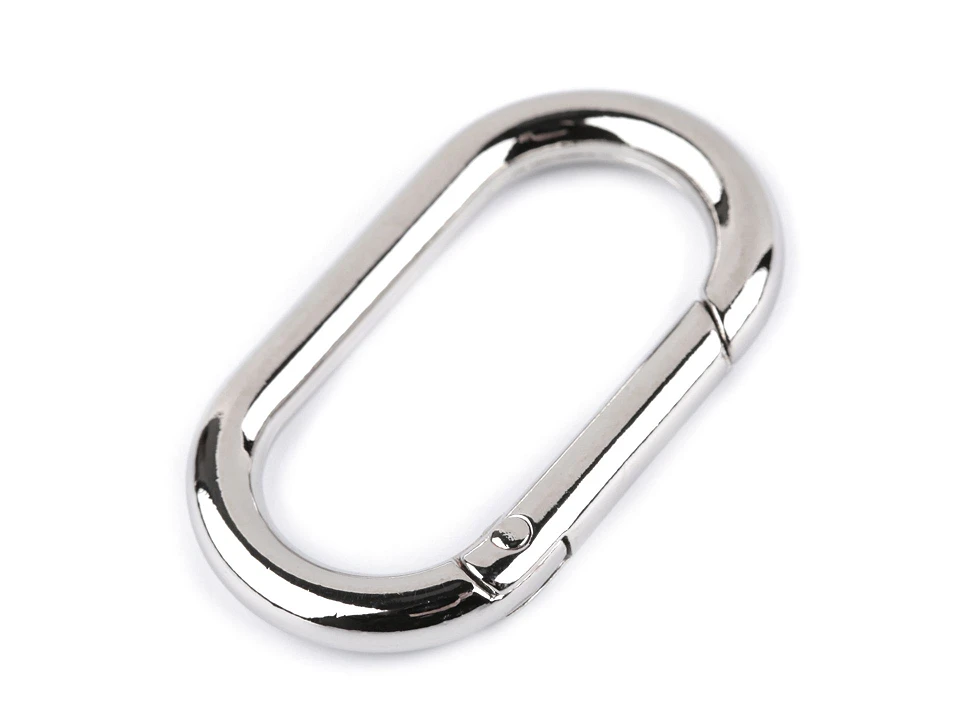
A reliable Chinese carabiner manufacturer is a verified factory (not a trading company) with region-appropriate specialization, valid EN 12275/UIAA or ANSI certification for load-rated products, in-house forging, and a willingness to submit samples for third-party lab verification. Audit business licenses, the NANDO certificate registry, and factory videos before ordering.
First, Define What Kind of Carabiner You Actually Need
The market splits into two categories: load-rated life-safety equipment, and non-load-bearing accessories. That split determines which Chinese factories can legally supply your product, and roughly nine out of ten Chinese producers only make the accessory grade. If you don’t know which category you’re in before you start emailing suppliers, you’ve already lost.
Life-safety carabiners have to conform to specific engineering standards. For climbing and mountaineering, that’s EN 12275. Under EN 12275, a basic Class B non-locking carabiner has to withstand a minimum of 20 kN along its major axis with the gate closed. One kN is roughly 224.8 pounds of force, so 20 kN means the hardware needs to hold about 4,500 pounds before it lets go. EN 12275 testing keeps loading the carabiner until it either breaks or deforms enough to release the testing pins.
Industrial fall protection is a different standard: EN 362. Same 20 kN minimum, but the methodology is different — the load has to be sustained for three continuous minutes without failure, and every connector with a gate has to have a manual or automatic locking mechanism. This is the part that trips up buyers who assume “20 kN is 20 kN.” It isn’t. A climbing biner and a fall-protection biner can both hit the number and still be legally non-interchangeable.
Accessory carabiners are the keychain, water bottle, dog leash category. No life-safety rating, no destructive batch testing, and they’ll snap under fairly modest static loads. These must carry a “not for climbing” label. If you try to source safety gear from a factory that’s optimized for keychains, you will fail third-party testing. Every time.
| Category | Standard | Min. Break Strength | Typical Use | Approx. Unit Cost (FOB) |
|---|---|---|---|---|
| Mountaineering | EN 12275 | 20 kN (Major Axis) | Climbing, Alpinism | $0.40 – $2.00 |
| Industrial Safety | EN 362 | 20 kN (Major Axis) | Fall Protection | $8.00 – $18.00 (Steel) |
| Accessory | None | < 4 kN | Keychains, Leashes | $0.05 – $0.50 |
Where Carabiners Are Actually Made — China’s Manufacturing Clusters
Chinese manufacturing organizes into regional clusters, and sourcing from the right city keeps inland freight costs down and gives the factory immediate access to experienced sub-suppliers for anodizing and CNC tooling. That second point matters more than most buyers realize. A factory without a good anodizer three streets away is going to send your carabiners across the province and back for surface treatment, and you’ll feel it in the lead time.
Dongguan (Guangdong): Primary base for OEM and branded outdoor accessories. Factories in Houjie Town and the surrounding area handle high-volume hardware production. Close to Shenzhen and Yantian for fast export routing.
Wenzhou & Yongkang (Zhejiang): The old hardware capitals. High-volume, low-cost metal processing. This is your keychain-grade, promotional, and light-utility carabiner region. Do not source rope-access gear here.
Qingdao (Shandong): Northern cluster, specializes in heavy rigging, marine hardware, outdoor sports gear. Frequently produces forged steel components for industrial fall protection.
If your supplier’s address doesn’t sit inside one of these clusters, you’re almost certainly dealing with a trading company. There are exceptions, but not many.
The Factory-vs-Trading-Company Test
This is where most buyers get burned. Trading companies stack an 8–15% markup on top, and they insulate you from the actual production floor, which means you can’t see the problems until the container arrives.
To verify a supplier is a physical factory, ask for their Chinese business license (营业执照) and check it against the National Enterprise Credit Information Publicity System (GSXT) using the 18-digit Unified Social Credit Code. Then look at the “Business Scope” (经营范围) section. A real factory’s scope will contain manufacturing verbs — 制造 (manufacture), 加工 (process), or 生产 (produce). If the scope only lists 批发 (wholesale) or 进出口 (import/export), that entity is legally a trading company. Doesn’t matter what their website says.
Also check registered capital. Anything under 500,000 RMB is usually a small trading operation, not a manufacturing facility.
Next, request a VAT invoice (增值税专用发票). Real factories issue 13% or 17% VAT invoices to claim export tax rebates. If the company name on the invoice is different from the business license, you’re buying through a middleman. And finally — this is the one people skip because it feels rude — demand an unscripted video tour showing forging presses, CNC machines, raw aluminum stock. Not a slideshow. Not a pre-recorded reel. Live video, on WeChat, right now.
Certifications That Matter vs. Certifications That Are Cosmetic
Product certifications prove a carabiner meets physical safety requirements. Company certifications only prove the factory uses certain management systems. ISO 9001, BSCI, Sedex — all company certifications. None of them mean the product will pass a load test.
For life-safety carabiners, the product needs a valid EN 12275, EN 362, or UIAA 121 certificate. The UIAA lists 77 active safety label holders across 20 countries, including multiple registered laboratories operating in China (Jiangsu Zhongzheng Testing being one).
To verify a CE certificate, locate the 4-digit Notified Body number on the document. Cross-reference that exact number in the European Commission’s NANDO (New Approach Notified and Designated Organisations) database. Two forgery patterns come up over and over: a Notified Body number that isn’t actually authorized to test Category III PPE, and documents with mismatched fonts where someone photoshopped a new product name over an old certificate. The font one is embarrassing. It happens constantly.
How to verify a CE certificate in three clicks:
- Open the EU NANDO database.
- Search the 4-digit Notified Body number.
- Confirm the body holds active authorization for Regulation (EU) 2016/425 (personal protective equipment).
That’s it. If a supplier can’t survive three clicks, walk.
Load Testing — Why “Factory Test Report” Isn’t Enough
Internal factory reports have no verified chain of custody. Testing rigs drift out of calibration, staff cherry-pick the best-looking samples, and the QC manager reports to the same boss the sales manager reports to. You have to get independent verification. This isn’t optional on safety gear.
Send random production samples to a third-party lab — SGS, TÜV SÜD, one of the majors. SGS runs PPE testing facilities globally, including Notified Body 0598 in Finland and Approved Body 0120 in the UK. Ask for static tensile pull to failure along the major axis, the minor axis, and with the gate open. The gate-open number is the one that catches shortcuts in the pin design.
Proper batch evaluation uses three-sigma statistics. Manufacturing inconsistencies mean breaking strengths vary; test 100 carabiners and you get a normal distribution. The Minimum Breaking Strength stamped on the carabiner needs to sit three standard deviations below the mean, so that 99.7% of the batch clears the rated load. In practice a lot of Chinese factories quote a “rated” strength that’s basically the average, not the three-sigma lower bound, and that’s a huge difference on the tail of the curve.
Current per-unit walk-in costs for third-party carabiner testing in Chinese labs vary quite a bit, and are different from a full Category III CE certification package. Ballpark it when you’re budgeting, and get an actual quote from the lab.
Realistic Pricing Benchmarks
Unit costs move with material grade and MOQ, and not much else. For 7075-T6 aluminum climbing carabiners at 24 kN, FOB pricing from Chinese factories currently runs $0.40 to $2.00 per unit on standard 1,000-piece orders. Accessory carabiners in lower-grade 6061 aluminum or carbon steel come in at $0.05 to $0.50.
Industrial rescue carabiners in stainless steel are the expensive ones — $8.00 to $18.00 FOB. Stainless machines slowly and eats tooling faster than aluminum, and that shows up in the price.
Here’s the number to remember: if a supplier offers you a 7075 aluminum climbing carabiner for under $0.30, refuse the quote. It’s either cast aluminum instead of drop-forged (cast is brittle and prone to sudden fracture on the minor axis), or it’s recycled scrap with unpredictable grain structure. Sometimes both.
| Material / Grade | MOQ 1,000 Units | MOQ 5,000 Units |
|---|---|---|
| Accessory (Carbon Steel / 6061) | $0.15 | $0.05 |
| Climbing (7075 Aluminum, 24 kN) | $0.60 | $0.40 |
| Fall Protection (Stainless Steel) | $12.00 | $8.00 |
The Sample and Pre-Production Protocol That Filters 80% of Bad Suppliers
A structured sampling process kills off incapable suppliers before any deposits move. Four stages: reference sample, engineering sample, pre-production sample (PPS), and a golden sample physically sealed and signed by both parties. The golden sample is the one you point to when a factory tries to argue about a defect six months later, so don’t skip sealing it.
For outdoor hardware, mandate ASTM B117 salt spray testing. Marine-grade hardware has to survive 72 to 120 hours of continuous 5% sodium chloride fog without surface rust or pitting. Standard outdoor hardware needs a 48-hour minimum pass.
Physical inspection has to include gate action cycling. Press the gate 1,000 times to check for spring fatigue. It should snap back instantly with a sharp metallic click. Sluggish return means dirt ingress, bad pin alignment, or a spring that’s already giving up.
Contracts, IP Protection & Payment Terms
Never pay 100% upfront. Standard terms are 30% T/T deposit to start tooling, remaining 70% against the Bill of Lading copy, or right after a passing third-party inspection report. If a factory pushes for 50/50 with no third-party inspection clause, that tells you something about their previous customer relationships.
Before you send CAD files or proprietary designs anywhere, register your trademark in China. The CNIPA charges an official fee of 270 CNY (around $37 USD) per class for electronic filing. Total out-of-pocket, including local agent fees, runs $400 to $1,500 USD per class. Registration takes 6 to 9 months and gives you 10 years of protection.
Protect IP with a Non-Use, Non-Disclosure, Non-Circumvention (NNN) agreement written under Chinese law. A standard US or European NDA is worth nothing in a Chinese court — literally nothing, and I still see buyers show up in 2026 clutching a Delaware-jurisdiction NDA and expecting it to work. And include a distinct mold ownership clause stating you own the custom tooling once production ends. Otherwise the factory holds your molds hostage the day you try to move production.
Red Flags — When to Walk Away
- Unverifiable certificates: CE document with no 4-digit Notified Body number, or a number that fails a direct NANDO search.
- Video refusals: Factory is suddenly “confidential” or “under renovation” when you ask for a live video tour.
- Suspicious pricing: Quote sits 20–30% below the Dongguan or Wenzhou cluster average. That’s material substitution talking.
- Communication silos: Supplier operates entirely through personal WeChat accounts, no registered company email domain. Technical change requests get lost in chat, which is a whole separate problem.
- Inspection pushback: Factory won’t let SGS or QIMA auditors onto the production floor.
- Account name mismatches: Bank account is registered to an individual, or to a different entity from the business license.
Any two of these together, walk. Any one of the first two, walk.
FAQ
What certifications should a reliable Chinese carabiner manufacturer have?
For load-rated carabiners, EN 12275 or EN 362 with a verifiable Notified Body number. UIAA 121 is the standard for climbing. ISO 9001 is management, not product safety.
What is the typical MOQ for custom carabiners from China?
Accessory carabiners usually run 1,000 to 5,000 pieces MOQ. High-strength 7075 aluminum climbing carabiners generally start at 1,000 pieces per color or style — the color point matters, because anodizing runs are batched separately and each color is effectively its own MOQ. Custom stainless steel hardware may allow lower runs but the tooling amortization is heavier upfront, so per-unit costs climb fast at low volumes, and some factories will quietly refuse rather than quote you a number that would embarrass them. Ask twice.
How can I verify a carabiner factory in China is not a trading company?
Search the business license on GSXT. The Business Scope has to include manufacturing verbs like 生产 or 制造. Then request VAT invoices and a live video tour.
Can Chinese factories produce genuine UIAA-certified carabiners?
Yes. Verify the factory name against the official UIAA member registry, not the logos on their Alibaba storefront.