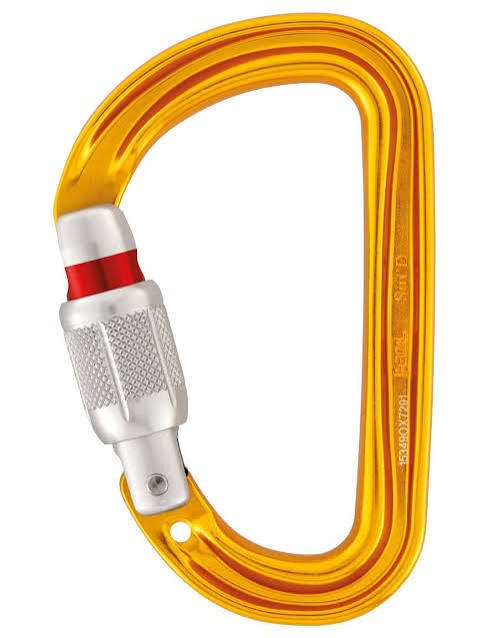
Use a triple-lock carabiner for any life-safety connection you can’t visually monitor throughout use. That covers rope-access critical connections, industrial fall arrest, tower rescue anchors, and unattended belay master points. Screw-gates are still fine for monitored climbing. Triple-locks aren’t required for top-rope belaying by an attentive belayer, though standards like ANSI Z359.12 do require auto-locking connectors with at least two consecutive deliberate actions for industrial fall arrest.
The Actual Failure Mode Triple-Locks Are Designed to Prevent
Triple-lock carabiners exist to prevent a specific chain of mechanical failures: gate flutter combined with a screw-gate loosening on its own. When a rope runs rapidly through a carabiner, or when the connector sits against a vibrating surface like a chainsaw lanyard or a helicopter winch, the friction slowly rotates a standard screw-gate sleeve. Once the sleeve unscrews, the carabiner is effectively a non-locking one.
That’s when gate flutter matters. Gate flutter is what happens when a sudden impact or vibration whips the solid gate open for a split second. Sustain peak loading in that exact millisecond and breaking strength collapses. An aluminum carabiner rated for 24 kN closed might hold only 7 kN open.
The triple-action mechanism goes directly after this. Opening the gate means pulling the sleeve up (or down), twisting it 90 degrees, and pushing the gate in. The internal spring damps out the external forces of rope slap and keeps the gate seated firmly against the nose. That’s the redundancy against accidental opening from shifting ropes or other hardware banging into it.
This is the part everyone glosses over though: the triple-lock only protects you if the gate can actually close. If the nose is packed with mud, or the sleeve’s already gummed up, no amount of clever engineering saves you. You still have to look at the thing.
What Safety Standards Actually Require (and Don’t)
No major standard mandates the phrase “three actions.” Standards regulate the minimum number of deliberate actions to open a connector, and leave the mechanism to manufacturers.
The European work-at-height standard, EN 362:2004, requires all connectors to feature either a manual or automatic gate-locking device. EN 362 tests connectors gate-closed and requires a Class B (basic) connector to withstand at least 20 kN on the major axis.
In North America, ANSI Z359.12-2019 sets a higher baseline for industrial fall protection. Connectors must be self-closing and self-locking, and must require at least two consecutive deliberate actions to open. Z359.12 also mandates a 5,000 lb (22.2 kN) tensile capacity and a 3,600 lb (16 kN) gate face and side load strength — that last number matters, because it’s what prevents an incompatible connection from levering the gate open under load.
For recreational climbing, EN 12275 is the relevant standard. Unlike EN 362, EN 12275 permits non-locking carabiners and tests specific classes with the gate open.
| Standard | Activity | Locking Requirement | Triple-Lock Required? |
|---|---|---|---|
| EN 362 | Work at Height | Manual or Automatic | No |
| ANSI Z359.12 | Fall Arrest | Auto-locking (2+ actions) | No, but often recommended |
| EN 12275 Class H | Climbing Belay | Manual or Automatic | No |
| OSHA 1926.502 | Construction | Self-locking | No |
Rope Access & Industrial Work — Where Triple-Locks Are Non-Negotiable
Rope access is built around the idea of a “critical connection”: a single point of failure between the technician and their safety or working line. That’s the framing that drives every equipment choice in the industry.
IRATA’s ICOP is more permissive than most people think. Section 2.7.7 of the IRATA manual says carabiners must have a minimum 2-way action gate locking mechanism, and it lists screwed sleeves alongside automatic locking mechanisms as acceptable. So technically, a screw-gate meets IRATA spec. In practice, nobody I’ve worked with in the last decade specs one for a critical connection.
The reason is boring and statistical. Technicians do hundreds of changeovers a shift. Some fraction of those, a human forgets to spin a screw-gate closed. The paperwork says “check it,” and 99% of the time people do. The 1% is what kills you. When paired with a backup device like an ASAP or a Duck, the connector has to limit force on the user to a maximum of 6.0 kN if the working line fails — and a non-locking carabiner absorbing a dynamic shock load is the exact scenario that produces roll-out.
Wind-energy technicians under GWO frameworks follow the same protocol. Unmonitored anchors, tools tethered to a harness, primary fall-arrest lanyards. All auto-locking. Not because the standard says so, but because 80 meters up, in gusts, with cold fingers, you plan around human error.
I still spec screw-gates for my personal rescue kit ground bag, even though the “correct” answer is triple-lock everything. Old habit from crevasse work. Not defensible on paper.
Climbing Scenarios — Where They Help, Where They Hurt
For recreational climbing, context decides. Attaching a mechanical belay device like a GRIGRI or NEOX to a harness involves constant rope movement and body shifting. Petzl explicitly recommends an auto-locking carabiner — their TRIACT-LOCK or BALL-LOCK — for these devices, because the rope will rub against a manual sleeve and unscrew it over the course of a session.
Multipitch master points also benefit. When a belayer is managing two followers and organizing gear on a cramped ledge, the master point is often out of direct visual contact. A triple-lock keeps the primary connection secure despite shifting slings.
Triple-locks are terrible as quickdraws. Non-locking wiregates are still the standard for lead protection because of speed and weight, and nothing about that has changed.
| Scenario | Recommended Locker Type | Rationale |
|---|---|---|
| Belay Device (GRIGRI) | Triple-Lock or Double-Lock | Constant rope movement unscrews manual gates |
| Master Point Anchor | Triple-Lock | Unmonitored connection, shifting slings |
| Ice Climbing | Screw-Gate | Triple-action mechanisms freeze; heavy gloves |
| Lead Climbing Draws | Non-Locking Wiregate | Speed is life; clipping an auto-locker mid-crux is a mistake |
Rescue, Rigging, and Confined Space — The Redundancy Question
Rescue systems generate large system forces and combine heavy static loads with the unpredictable movement of litters and personnel. That’s the operating envelope, and it’s why redundancy conventions in rescue tend to be stricter than the base standards require.
NFPA 2500 — which absorbed NFPA 1983 in the 2022 edition — governs auxiliary equipment for emergency services. NFPA rates carabiners for General Use (G) at 40 kN major axis, and Technical Use (T) at 22–25 kN depending on material. Auto-lock models must fully engage and lock the gate each time it closes.
ICAR’s Terrestrial Rescue Commission updated Recommendation 0001 in 2022, advising that organized mountain rescue use exclusively triple-action or screw-gate carabiners for main central attachment points.
Rescue rigging often involves Z-drag mechanical advantages or confined-space entries where the anchor is physically out of sight of the operator. The heuristic riggers actually use is simple: if you can’t see the master attachment point, it gets a triple-lock. That’s not in any standard. It’s just what everyone does.
The Downsides — Cold, Gloves, Speed, and Complacency
Triple-lock carabiners introduce distinct operational hazards in extreme environments.
The internal spring that drives a triple-action sleeve is highly susceptible to freezing. Winter climbers and alpinists who encounter rain that turns to ice will find moisture penetrating the sleeve housing. Once frozen, the triple-action gate becomes permanently locked, or worse, jams open.
Gloved operation is a secondary problem. A push-and-twist mechanism needs fine motor control, and thick winter gloves don’t allow it. Alpine climbers report real difficulty running triple-actions in crevasse rescue setups. A standard screw-gate gives you high friction for gloved hands, and you can crush thin ice buildup by rotating the sleeve manually against it.
In time-critical scenarios the triple-action mechanism just slows changeovers. Not by much. But a rescuer transferring a load can lose real seconds fighting a sticky auto-lock, and those seconds compound across a long operation.
The last downside is behavioral, and it’s the one nobody wants to talk about. Auto-locking carabiners breed complacency. A worker who’s used to the carabiner locking itself will eventually stop visually verifying closure. And if mud, sand, or a small twig blocks the gate from seating against the nose, the sleeve can’t engage. What the operator is holding then is a non-locking, open-gate carabiner that looks locked from a distance. This failure mode is the direct inverse of the one the triple-lock was invented to prevent, and it’s more common than manufacturers like to acknowledge.
Triple-Lock vs. Ball-Lock vs. Magnetic vs. Screw-Gate
| Type | Actions to Open | One-Hand? | Gloved Use | Best For | Weak Point |
|---|---|---|---|---|---|
| Triple-Lock (TriAct) | Push sleeve up, twist, open | Yes, with practice | Poor | Industrial work, belay devices | Freezes in winter |
| Ball-Lock | Press green button, twist, open | Yes, with practice | Very Poor | Confined space, gym belaying | Button unusable with gloves |
| Magnetic | Pinch sides, open | Yes, very easy | Good | Sport climbing | Magnets attract iron sand/grit |
| Screw-Gate | Rotate sleeve, open | Yes | Excellent | Ice climbing, alpine rescue | Vibrates open under rope slap |
Petzl’s Ball-Lock adds a green visual indicator button that has to be depressed before twisting the sleeve. Extreme security against friction, but you basically need bare hands to use it efficiently. Magnetic carabiners like the Black Diamond Magnetron use steel inserts in the nose and magnetic arms in the gate. Fast, but the magnets will grab iron sand and gum up the mechanism.
Obviously you wouldn’t run a magnetic on a coastal SAR kit.
A Practical Decision Framework
Picking a carabiner is a structured evaluation of environment, connection type, and operator constraints. Work through it in order:
- Is the connection life-safety?
If no (racking gear, hauling small tools), non-locking wiregate. - Is a specific workplace or rescue standard triggered?
Default to the standard requirements. ANSI Z359.12 requires auto-locking with two consecutive actions. - Is operator dexterity constrained by heavy gloves or ice?
Use a high-quality screw-gate. The leverage you need to break ice off the sleeve makes it the only viable choice for extreme alpine work. - Is the connection visually monitored throughout use?
Out of sight — remote tree anchor, confined space redirect, busy master point — triple-lock. Directly in front of the operator, like a standard top-rope setup, screw-gate is fine.
Rule of thumb: monitored connections allow screw-gates. Unmonitored life-safety connections demand a triple-lock.
FAQ
1. Is a triple-lock carabiner required for lead belaying?
No. EN 12275 Class H covers HMS carabiners intended for dynamic belaying, and it permits both manual screw-gates and automatic locking carabiners. A screw-gate is fully certified and safe for lead belaying.
2. Can a screw-gate carabiner really open by itself?
Yes. When a rope slaps against the locking sleeve, or when the carabiner rests against a vibrating surface, mechanical friction acts against the threads. Over prolonged unmonitored use, this can rotate the sleeve down and unlock the carabiner. This is well-documented across every major manufacturer’s user manuals, it’s the entire reason auto-locking mechanisms exist, and it’s why belay-device manufacturers specifically recommend against pairing their products with screw-gates for extended sessions. If you’ve ever finished a long belay session and glanced down to find your locker half-open, that’s what happened.
3. Do I need a triple-lock for via ferrata?
No. Via ferrata sets require EN 12275 Class K connectors. Class K carabiners have to be auto-locking, but they typically use a double-action squeeze mechanism — pressing the back of the spine and the gate at the same time — rather than a triple-action sleeve.
4. Why do rope access technicians prefer triple-lock carabiners?
Hundreds of line transfers a week. Relying on an operator to manually spin a screw-gate shut that many times introduces real human error. Auto-locks remove that variable.