Auto-lock carabiners are statistically safer against user error. Screw gates can be equally safe when used correctly, and they hold up better in mud, grit, or freezing conditions. The honest answer to “which is safer” depends on the job: belay, anchor, and industrial PPE each pull you toward different mechanisms.
1. The Mechanical Difference That Actually Matters
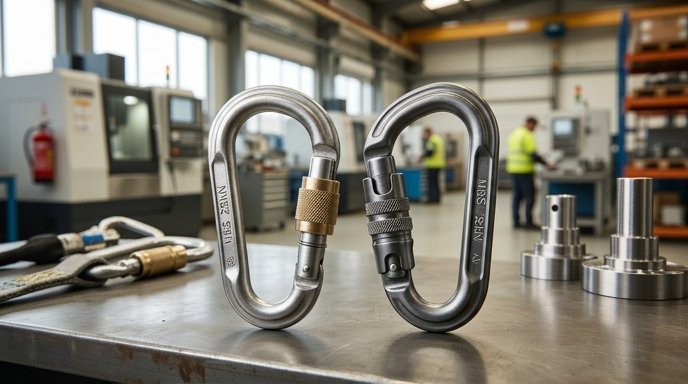
A screw gate is a locking carabiner that needs you to manually rotate a sleeve to secure the gate. An auto-lock uses a spring-loaded mechanism that requires two or three deliberate actions to open. The real distinction is the default state of the sleeve. A screw gate sits unlocked until you intervene. An auto-lock snaps to locked the instant the gate closes.
That matters because carabiners lose roughly two-thirds of their strength when the gate is open. The Petzl Am’D is rated to 27 kN along its major axis closed, and drops to 8 kN with the gate open. The Black Diamond RockLock Screwgate goes from 24 kN closed to 8 kN open. Same story across almost every locker on the market.
Auto-locks come in two flavors:
- Two-action (twist-lock): twist the sleeve, pull the gate.
- Three-action (triple-lock): push or pull the sleeve, then twist, then pull the gate open.
| Feature | Screw Gate | Two-Action Auto-Lock | Three-Action Auto-Lock |
|---|---|---|---|
| Default State | Unlocked | Locked | Locked |
| Actions to Open | 1 (unscrew) + pull | 2 (twist, pull) | 3 (push/pull, twist, pull) |
| Risk of Forgetting to Lock | High | Zero (if functioning) | Zero (if functioning) |
| Complexity | Low | Medium | High |
2. Where Each One Fails in the Real World
Hardware failure is genuinely rare in climbing and rope access. Mechanism-specific failures are not. The American Alpine Club’s Accidents in North American Climbing database cites “Inadequate Belay” and “Equipment Failure” constantly, but when you read the actual incident reports, carabiners almost never break. They open.
Screw gates fail through vibration or friction. A rope running repeatedly across a locked screw sleeve can roll the sleeve the wrong way, unscrewing it. Once that gate is unlocked, rope movement or a nudge against rock can push it open, and now you have a rollout.
Auto-locks fail differently. The spring-loaded sleeve can snag on webbing, a belay loop, or an adjacent piece of gear. If something holds that sleeve open, the gate can open with it. They’re also more prone to cross-loading in practice, because users trust the auto-lock and stop watching orientation. A cross-loaded Am’D is rated to 8 kN. Compared to its 27 kN major axis strength, that is a bad day waiting to happen.
3. The User-Error Paradox
Auto-lockers eliminate the “I forgot to lock it” error and introduce a different family of errors in exchange. Hardware built to be foolproof tends to breed operator complacency, and this is where the paradox bites.
The nastiest auto-lock error is the nose hook. The gate catches on the nose of the carabiner body instead of seating fully into the closure. The spring-loaded sleeve snaps forward anyway, so the biner looks locked, feels locked, sounds locked. It isn’t. Black Diamond’s QC Lab has shown that a nose-hooked carabiner only holds its open-gate strength, somewhere in the 7 to 9 kN range.
Screw gates force you to physically interact with the lock. Spinning that barrel down gives you tactile feedback that something actually happened. With a triple-action, people let the gate snap home and move on without a visual or tactile check. I still catch myself doing it.
4. Mud, Ice, Sand, and Saltwater: Environmental Reality
This is the section where I have opinions.
Environmental contamination dictates carabiner choice in harsh conditions, full stop. Auto-locking mechanisms depend on small internal springs and tight tolerances between the sleeve and the gate. Introduce mud, sand, grit, salt crust, or freezing rain, and those tolerances turn against you. Petzl says this out loud in their own technical notices: screw-locks are preferable where dirt, mud, or ice are present. If a three-action sleeve packs with grit, the spring may not drive the sleeve back to locked, and you have effectively converted a locking carabiner into a non-locking one without knowing it. Worse case, it jams while locked and you can’t open it to escape the system, which is the kind of problem that ruins a rescue.
Screw gates are mechanically dumb in the best possible way. The threads will push through moderate ice or dirt. If one freezes shut you can usually crack it with a nut tool or just brute force and body heat. Caving, alpine, and winter climbers lean on screw gates for exactly this reason, and you’ll pry mine out of my cold hands before I take a triple-action into a wet, muddy anchor rebuild.
Obviously you wouldn’t bring a keylock-nose auto-lock into a sandy sea-cliff rebolting day either, but people do, and then they wonder why nothing works by lunch.
5. What the Certifications Actually Guarantee (and Don’t)
Carabiner safety is governed by testing standards that measure strength. They do not measure foolproof operation, and that distinction gets lost constantly.
EN 12275 certifies mountaineering carabiners. It requires a minimum major axis strength of 20 kN for Type B (Basic) and Type H (HMS) carabiners, and 7 kN open-gate. EN 12275 does not distinguish between screw gates and auto-locks for safety.
The real distinction lives in the industrial standards. EN 362, the European standard for personal fall protection connectors, requires self-closing and self-locking for certain applications. In the US, ANSI Z359.12 governs connecting components for fall arrest systems and demands the gate face and side withstand 3,600 lbs (16 kN) of force. Recreational climbing carabiners certified only to EN 12275 are not tested to that gate-strength bar. This is why your dirtbag trad rack is not legal PPE at a jobsite, no matter how expensive it was.
| Standard | Application | Major Axis Requirement | Gate Strength Requirement |
|---|---|---|---|
| EN 12275 (Type H) | Recreational Climbing | 20 kN | 7 kN (open) |
| UIAA 121 | Recreational Climbing | 20 kN | 7 kN (open) |
| EN 362 (Class B) | Industrial PPE | 20 kN | Not specified for side load |
| ANSI Z359.12 | Fall Arrest / Industrial | 22.2 kN (5,000 lbs) | 16 kN (3,600 lbs) face/side |
6. Matching the Carabiner to the Job
Pick the mechanism to fit the job:
- Single-pitch belay: auto-lock, three-action. You’re distracted, the rope’s moving, and forgetting to lock is the single most common belayer error.
- Multi-pitch anchor master point: screw gate. Anchors stack carabiners close together, and screw gates are lighter, less bulky, and one-handed friendly while you’re building.
- Personal tether / lanyard: auto-lock. When you’re clipped in for your own life, you want self-locking.
- Via ferrata: auto-lock, Type K. Constant clipping and unclipping past anchors. Screw gates are too slow and the margin for forgetting is zero.
- Rope access and fall arrest: auto-lock, ANSI Z359.12 or EN 362 compliant. OSHA 1926.502 requires self-closing, self-locking connectors.
- Alpinism and caving: screw gate, for the mud and ice reasons above.
7. The Partner Check Is Still the Biggest Safety Factor
Hardware choice is secondary. Verification is primary. A triple-action gives you nothing if it’s cross-loaded, and a screw gate is perfectly safe if you confirmed it’s closed.
AAC data points to human error over mechanical failure, over and over again. Lack of a partner check shows up as a contributing factor in the vast majority of belay-related incidents.
A real partner check means looking at the carabiner, squeezing the gate to confirm it doesn’t open, and checking that the load sits along the major axis. The click of an auto-lock snapping shut is not a check. It’s a noise.
FAQ
1. Can a screw gate carabiner unscrew itself from rope vibration?
Yes. If the rope runs tightly across the sleeve in a downward direction, friction can roll the sleeve open. Orient the carabiner so the rope runs over the spine, not the gate.
2. Are triple-action carabiners safer than twist-locks?
Mechanically, yes. A twist-lock only needs two motions and can occasionally be defeated if the sleeve rubs against rock or webbing just right. A triple-action requires a vertical push or pull before the twist, which makes accidental opening pretty improbable in normal use. Not impossible, improbable. I’ve still seen triples catch on a belay loop and sit half-open, so none of this gets you out of actually looking at the gate before you weight it.
3. Why do professional guides often prefer screw gates?
Simplicity, weight, and reliability across weather. Guides juggle complex systems with multiple ropes and lockers, and screw gates give you clean one-handed operation without mechanisms jamming.
4. Is an auto-lock carabiner required by OSHA for work at height?
Yes. OSHA 1926.502 requires self-closing and self-locking snaphooks and carabiners in fall arrest systems. Screw gates don’t qualify.
5. How often should I replace a locking carabiner?
Replace it if it’s been dropped from a significant height onto hard ground, if the gate stops closing automatically, if the sleeve is deformed, or if rope wear exceeds 1mm in depth on the basket.