D-shape carabiners are stronger than ovals of equivalent material and size, typically rated 24–27 kN versus 23–25 kN on the major axis, because the asymmetric geometry forces load onto the solid spine. Ovals still win in symmetric-loading applications like pulleys and aid ladders, where gear alignment matters more than peak strength.
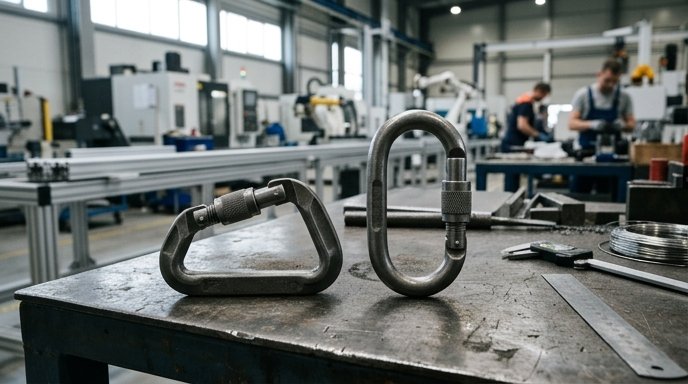
The Geometry That Decides Everything
Carabiner shape determines strength because it dictates how force travels through the metal frame. An oval distributes a load roughly equally across its two sides. When weighted, the solid spine takes about half the force and the gate side takes the rest. The gate, relying on a small steel pin and a spring, is the weakest point of any carabiner. Always has been.
A D-shape alters this geometry to protect the gate. The asymmetric design shifts the load path away from the opening, so when a rope pulls tight it slides into the narrowest point of the “D,” which sits directly in line with the spine. The solid aluminum or steel spine ends up carrying the vast majority of the load. By keeping force off the gate, a D-shape achieves higher major-axis ratings using the same amount of metal.
What the kN Numbers Actually Tell You (and What They Hide)
The kN rating on a carabiner is the force at which it fails under laboratory conditions, measured on three axes. One kilonewton is roughly 225 pounds of force. The UIAA 121 standard requires a minimum major-axis strength of 20 kN for standard carabiners.
Comparing current models from Petzl and Black Diamond gives you the actual deltas between shapes.
| Model | Shape | Major kN | Minor kN | Gate-Open kN | Weight | Material |
|---|---|---|---|---|---|---|
| Petzl Am’D | Asymmetric D | 27 kN | 8 kN | 7 kN | 70g | Aluminum |
| Petzl OK | Oval | 25 kN | 8 kN | 7 kN | 70g | Aluminum |
| BD LiteWire | Asymmetric D | 24 kN | 8 kN | 8 kN | 32g | Aluminum |
| BD Oval Keylock | Oval | 23 kN | 9 kN | 7 kN | 58g | Aluminum |
Notice the Petzl Am’D and the Petzl OK weigh exactly 70 grams. The D-shaped Am’D provides 2 kN (about 450 lbs) more major-axis strength from the same lump of aluminum.
The minor-axis and gate-open ratings stay nearly identical across shapes. Minor-axis strength is bottlenecked by the gate pins, typically 2mm stainless pins that shear somewhere in the 8–9 kN range regardless of what the frame around them looks like.
Where the Oval Quietly Wins
Ovals remain mandatory for specific rigging and climbing jobs. Pulleys require symmetric loading. Devices like the Petzl Micro Traxion or a standard rescue pulley have side plates that need to sit evenly on the connector. Hang one on an asymmetric D and the pulley shifts toward the spine. The plates bind against the rope, friction goes up, wear accelerates, and you’ve engineered a problem that didn’t need to exist.
Aid climbers prefer ovals for the same reason that becomes obvious the first time you rack a dozen nuts on a D. The symmetric bottom basket keeps gear from piling to one side, so you can actually find the piece you want. The CMC Rope Rescue Field Guide specifies ovals for haul systems because predictable gear positioning helps prevent cross-loading during complex rigging. Rescue folks have been quietly running ovals on their mainlines for years while the sport-climbing crowd forgot ovals existed.
Where the D-Shape Earns Its Reputation
The asymmetric D dominates modern climbing racks. Quickdraws, belay station anchors, primary tie-in points — all of them lean on D-shapes for strength-to-weight.
Yvon Chouinard introduced the first rigid aluminum D carabiner in 1968, which changed the standard away from heavy steel ovals. The classic D later evolved into the asymmetric (or offset) D to increase gate clearance; by widening the top basket, manufacturers made it easier to clip ropes while keeping the spine-biased load path. A modern asymmetric D like the Petzl Spirit weighs just 37 grams and holds 23 kN. Getting that same 23 kN rating out of an oval takes 58 grams of aluminum, which is what the Black Diamond Oval Keylock weighs.
Use cases ranked by preference for D-shapes:
- Quickdraws — offset Ds win on weight and gate clearance.
- Anchor master points. Locking Ds offer the highest major-axis strength for primary attachments, which is the whole point.
- Belay carabiners: HMS (pear) carabiners are really just a variation of the asymmetric D, widened to accommodate a Munter hitch or tube-style device.
Failure Modes Nobody Puts on the Spec Sheet
The spec sheet assumes perfect loading. Real falls don’t.
Most carabiner failures in the field happen because the biner was loaded in a direction its rating didn’t cover. Cross-loading, where the carabiner gets pulled across its minor axis, hammers both D-shapes and ovals. Strength drops from 24+ kN to around 8 kN. Same story for both shapes.
Nose-hooking is nastier. If a carabiner snags on a bolt hanger by its nose, the gate stays open and the spine takes multiplied force because of the mechanical advantage. Black Diamond’s QC Lab pull tests put nose-hooked failures between 1.7 kN and 2.8 kN. That’s 400–600 pounds, which a minor slip on a sport route will produce without trying.
Gate flutter, where the gate vibrates open during a dynamic fall, drops you to the gate-open rating. Both shapes use the same gate pin mechanisms, so both drop to 7–8 kN during a flutter event.
Material and Manufacturing — The Hidden Variable
Shape is one variable. Material sets the baseline. Most climbing carabiners use 7075-T6 aluminum, a zinc-primary alloy with an ultimate tensile strength of 572 MPa (83,000 psi).
Switch to steel and the math changes entirely. A steel oval like the Petzl OXAN is rated 38 kN major axis, 16 kN minor, and weighs 185 grams. That steel oval outperforms any aluminum D on the market in raw strength, which is the easy proof that material supersedes geometry — obviously you wouldn’t carry a rack of OXANs up a sport route, but for a fixed anchor in a rescue system it’s a different conversation.
Manufacturing matters too. Hot forging lets companies cut I-beam cross-sections into the frame, pulling material out of low-stress zones and piling it along the load path. That’s how a 32-gram aluminum D clears the 20 kN UIAA bar at all.
Choosing by Use Case
Picking between a D and an oval mostly comes down to matching the geometry to whatever’s hanging off it.
- Attaching a pulley or a device with side plates? Oval. The symmetry stops it binding.
- Racking aid gear that needs to slide freely? Oval. The wide bottom basket keeps gear from bunching.
- Building a quickdraw for sport climbing? Asymmetric D — you gain strength and save weight.
- Setting up a belay device? HMS (pear), which is basically a wide-basket D built to let the rope move.
- Need the highest possible strength for the lowest weight? Asymmetric D.
I’ll admit I still throw an oval on my belay loop for a Grigri sometimes, even though an HMS is the textbook answer. Habit from older devices, not a defensible choice.
FAQs
Is an oval carabiner strong enough for lead climbing?
Yes. UIAA 121 requires a minimum of 20 kN major-axis, and most aluminum ovals hold 23–25 kN, well above the force a severe lead fall generates.
Why do aid climbers prefer oval carabiners?
The symmetric basket keeps gear from sliding to one side and bunching up. When you’re hanging off a daisy chain trying to find one specific offset nut buried in a loop of twenty pieces, that matters more than you’d think from the ground. The wide top also means pitons and heavier aid gear sit flatter against the biner instead of torquing to one side, which helps when you’re clipping and unclipping dozens of times a pitch.
What’s the difference between a D and an asymmetric/offset D?
Classic D is symmetric top-to-bottom. Asymmetric D is wider at the top basket, which gives you more gate opening clearance while still biasing load toward the spine.
Can I use an oval carabiner for belaying?
Not recommended for tube-style devices or the Grigri. The narrow basket restricts device and rope movement. HMS is the standard.
Does gate-open strength matter in real falls?
Yes. Gate flutter or gate-on-rock contact during a fall drops you to the gate-open rating, usually 7–8 kN, which a hard lead fall can exceed.