TL;DR: An HMS carabiner is a pear-shaped locker built for belaying, rappelling, and anchoring. The wide basket gives a Munter hitch room to flip without jamming. Most HMS models rate 22–25 kN on the major axis, but the same wide geometry that makes them useful also makes them easier to cross-load, and their minor-axis numbers tend to be lower than a D-shape’s.
The Shape That Defines the HMS
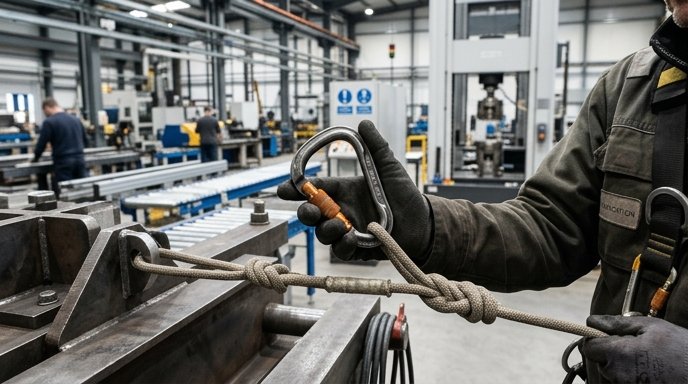
The pear shape has one job: give a Munter hitch enough room to flip without binding. An HMS is noticeably asymmetrical compared to a standard D. The top end, the basket, flares out, and that wide radius lets two strands of a 8.5–10.5mm rope sit side by side without pinching.
The European standard EN 12275 classifies these as “Type H” connectors. To earn the stamp, the carabiner has to meet minimum strengths of 20 kN on the major axis, 7 kN on the minor axis, and 5 kN with the gate open.
Five parts worth knowing if you’re going to talk about these things sensibly:
- Basket: the wide, curved top where the rope or belay device sits
- Spine: the solid, non-opening side
- Gate: the hinged bit
- Stock: the metal body itself, usually forged from 7075 aluminum
- Minor axis: the horizontal width, gate to spine
Where the Name Comes From (And Why It Matters)
HMS is short for Halbmastwurfsicherung, German for “half clove hitch belay.” English-speaking climbers call that knot the Munter hitch.
That history is the whole design brief. The carabiner was built around a rope technique, not the other way around. When you belay or rappel on a Munter, the knot physically inverts — flips — every time the rope direction reverses between taking in slack and holding weight. Narrow basket, and the knot jams against the spine and the gate, which generates friction and, worse, can slowly spin a screwgate open. The flared pear prevents the jam. That’s it. That’s the design.
Primary Use Cases Where HMS Is the Right Call
Four scenarios where I reach for an HMS without thinking:
- Belaying with tube-style devices: ATC, Reverso, whatever. The wide basket lets the device and rope move freely.
- Rappelling with an autoblock backup: enough room for the rap device and the friction hitch to coexist without one eating the other.
- Master point of a multi-pitch anchor: fits a bulky BHK or figure-eight on a bight plus whatever carabiners the party has clipped in.
- Munter belay or rappel: if your belay device goes for a swim, an HMS plus a Munter gets you home.
| Use Case | Why HMS Wins | Alternative if HMS Unavailable |
|---|---|---|
| Tube belay device | Smooth rope feed, device moves freely | Offset-D locker |
| Munter hitch | Knot flips without jamming | None (unsafe with narrow carabiners) |
| Anchor master point | Fits thick knots and multiple carabiners | Large asymmetrical D |
Where HMS Is the Wrong Choice
An HMS is the wrong carabiner in more situations than it’s the right one. The same wide basket that makes it great for a Munter makes it a liability elsewhere.
Don’t put one on a quickdraw. The basket lets the carabiner rotate in the bolt hanger or the dogbone, and that rotation is how cross-loads happen. HMS carabiners also weigh a lot more than a wiregate — often 80g-plus versus 35g — which adds up fast on a long sport route.
HMS carabiners also pair badly with some assisted-braking devices. Petzl explicitly says to use an asymmetrical D like the Am’D or a compact D like the Sm’D with the Grigri, not a big HMS. Clip a Grigri into something like the William and the device slides around the basket, levering against the gate, and now you’ve built a cross-load failure waiting to happen. Edelrid goes the other direction with the Mega Jul and tells you to use their HMS Strike FG specifically, because narrower carabiners can jam the device’s braking mechanism. Obviously you wouldn’t try to run a Mega Jul on a small Sm’D and expect it to behave.
Read the manual that came with your device. People skip this.
Locking Mechanisms Compared for HMS Carabiners
Because HMS carabiners live at critical failure points — belay loop, anchor master point — they’re always lockers.
Screwgate. The default. Threaded sleeve, spin it up to lock. Lightest, cheapest, and the one you have to actually look at every so often, because rope vibration can walk them open.
Twist-lock / auto-lock. Spring-loaded sleeve, locks itself when you let go. Faster to use, but dirt and ice can foul them.
Triple-action. Push, twist, pull. Highest security for a master point. Takes a bit of practice to open one-handed in a hurry.
Captive-eye variants. The wide basket is cross-load bait on a belay loop. Manufacturers fix this mechanically. The DMM Belay Master uses a plastic clip that snaps over the gate and physically stops the carabiner from rotating. The Petzl Attache uses a removable plastic bar — the Captiv — to do the same thing. I spec the Belay Master for every intro student I teach, and I know the plastic clip annoys half of them. I don’t care. It works.
Reading an HMS Carabiner’s Strength Rating
Every certified HMS has three kN ratings stamped on the spine. One kilonewton is roughly 225 pounds of static force.
Major axis is end-to-end with the gate closed. Minor axis is side-to-side across the gate. Open gate is major-axis strength if the gate somehow fails to close.
HMS carabiners generally test lower on the minor axis than offset-Ds, and the reason is geometry: the wide basket parks the rope further from the spine, which gives the load more leverage against the weaker gate side. Per the American Alpine Club, cross-loading can shed up to 65% of a carabiner’s strength, and it’s turned up as a contributing factor in belay anchor failures.
| Model | Major Axis | Minor Axis | Open Gate | Weight |
|---|---|---|---|---|
| Petzl Attache | 22 kN | 7 kN | 6 kN | 58g |
| BD RockLock | 24 kN | 7 kN | 7 kN | 85g |
| DMM Belay Master | 25 kN | 10 kN | 8 kN | 93g |
Data from manufacturer specs.
Choosing Your First HMS Carabiner
Pick based on what you actually climb.
Gym and single-pitch sport: get a captive-eye HMS, either the DMM Belay Master or the Black Diamond GridLock. Ballpark $20–30 depending on where you shop. The captive feature eliminates the cross-loading problem that defines gym belaying, where the belayer stands around for an hour and the carabiner slowly rotates into the worst possible orientation.
Multi-pitch or trad: weight and versatility. The Petzl Attache is 58g, with a round stock that lets a Munter run smoothly. Figure around $22, give or take.
Avoid the no-name carabiners on generic e-commerce sites. If there’s no CE mark and no UIAA 121 stamp on the spine, it doesn’t go on a harness. Suspiciously light — under 50g for a full-size HMS — usually means the alloy is wrong or the certification isn’t real.
FAQ
What does HMS stand for on a carabiner?
Halbmastwurfsicherung — German for “half clove hitch belay.” The knot is the Munter hitch. The carabiner shape exists to make that knot work.
Can I use an HMS carabiner on a quickdraw?
No. Too heavy, and the wide basket lets it rotate in the bolt hanger, which sets up a cross-load during a fall. Use a dedicated sport draw.
Is an HMS carabiner strong enough for lead climbing?
Yes, when it’s loaded on the major axis. Certified HMS carabiners hold at least 20 kN, which is around 4,500 lbs — well beyond any lead fall. The caveat is that you use them for belaying and anchoring, not for clipping bolts on the way up. If you want to understand why the lead rope goes through sport draws and not an HMS, go back and reread the previous section on cross-loading, because the geometry is the whole story and it’s the single most common mistake I see new climbers make when they first buy a locker and think of it as a general-purpose carabiner they can clip anywhere.
What’s the difference between HMS and pear-shaped carabiners?
Same thing. “Pear-shaped” is the geometry, “HMS” is the technique the geometry was built around.