Steel rescue carabiners give you 40+ kN typical strength and roughly 3-5x the service life in high-cycle use. Aluminum weighs 60-70% less and makes sense when mobility matters more than longevity. Pick by application, not by shop default. Mixed-material systems are fine, provided somebody is actually inspecting them for uneven wear instead of just signing the logbook.
The Decision Framework in 30 Seconds
Steel for fixed industrial anchors, heavy haul systems, and structural fire overhaul. Aluminum for wilderness SAR, swiftwater, and personal harness attachments. Both when you’re building mixed systems and can isolate steel to the high-friction points.
No rescue team can standardize on one material without giving up either mobility or durability, and anyone selling you otherwise is selling you something. The matrix below maps rescue domains to primary material requirements, drawn from standard operating procedures used by municipal fire departments and rope access organizations.
| Application | Primary Recommendation | Why | Exception Case |
|---|---|---|---|
| Wilderness SAR | Aluminum | Weight savings (carrying 30+ carabiners for miles). | Helicopter hoist hooks (steel required). |
| Structural Fire / Overhaul | Steel | Heat resistance; 7075-T6 aluminum weakens above 150°C. | Personal bailout kits (aluminum). |
| Swiftwater Rescue | Aluminum | Corrosion resistance; lighter weight in water. | Fixed shore-based highline anchors. |
| Confined Space / Industrial | Steel | High abrasion resistance against concrete/steel edges. | Entrant’s personal harness connectors. |
| Training Towers | Steel | Survives thousands of cycles and drops without fatigue failure. | Trainees practicing with field-weight gear. |
Strength Ratings Decoded — What kN Actually Means Under Load
A carabiner’s kN rating is its breaking strength across three axes: major (spine-loaded), minor (cross-loaded), and gate open. One kilonewton is roughly 225 pounds of force.
A 27 kN aluminum carabiner and a 45 kN steel carabiner are not interchangeable in failure scenarios, even though both easily hold a standard two-person rescue load of 2 to 2.7 kN. Their behavior under improper loading is where they diverge. Steel deforms noticeably before breaking, which gives you a visual warning. Aluminum tends to snap when pushed past its yield point.
Minor axis and gate-open numbers are where the gap gets ugly. A cross-loaded aluminum carabiner often fails around 8 kN. A comparable steel model holds 16 kN in the same orientation and survives a shock load that would shatter the aluminum frame outright.
| Model | Material | Major Axis | Minor Axis | Gate Open | Weight | Est. Price |
|---|---|---|---|---|---|---|
| Petzl Vulcan (Triact) | Steel | 45 kN | 16 kN | 18 kN | 285g | $55 |
| Petzl Am’D (Triact) | Aluminum | 27 kN | 8 kN | 7 kN | 75g | $28 |
| SMC Large Rescue | Steel | 60 kN | 16 kN | 11 kN | 295g | $65 |
| CMC ProSeries | Aluminum | 31 kN | 11 kN | 9 kN | 147g | $49 |
The Fatigue Problem Most Buyers Ignore
Aluminum has no endurance limit. Every load cycle, no matter how small, contributes microscopic fatigue. Over thousands of cycles, aluminum will eventually fail even if the load never exceeds a fraction of its rated strength.
Steel has a true fatigue limit. Keep the load below roughly 50% of ultimate tensile strength and the metal can cycle indefinitely without accumulating damage.
For a wilderness SAR team running a dozen rescues a year, aluminum fatigue is mathematically irrelevant. For an industrial rope access training center running 50 haul cycles a day, it’s a primary failure vector. High-cycle haul systems, mechanical advantage pulleys, and permanent training anchors should be steel so you can take fatigue off the risk register entirely.
Wear, Grooving, and the Hidden System Failure
Rope running directly across an aluminum carabiner spine wears away the anodized coating and cuts into the softer 7075-T6 alloy underneath. As the aluminum wears, it develops burrs. Those burrs then act like a rasp on the nylon mantle of your rescue rope, which is the kind of failure that doesn’t announce itself until you’re inspecting a shredded sheath at the end of a shift. Steel resists this abrasion and holds a smooth radius after miles of rope travel.
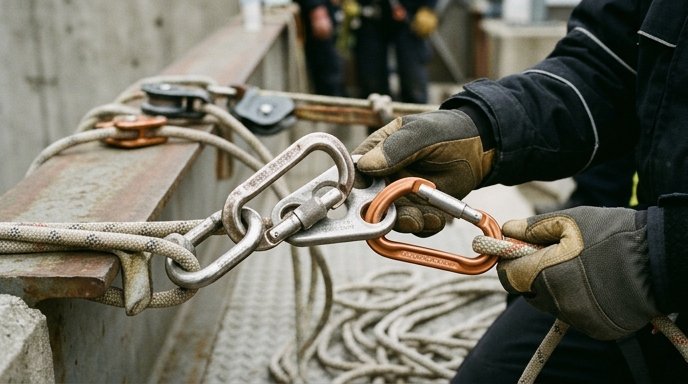
Mixing materials introduces a secondary hazard: galvanic grooving. Teams in the rope access community report, often loudly, that clipping a steel carabiner into an aluminum rigging plate like a Petzl Paw causes rapid damage. Under load, the harder steel cuts deep grooves into the softer aluminum. Clip an aluminum carabiner into that same groove later and the sharp edges left behind by the steel will gouge it.
Isolate steel to steel. Or accept that the aluminum components will need aggressive inspection and early retirement. Manufacturer guidelines generally say retire anything with wear deeper than 1mm, though in practice I pull hardware well before it hits that number — old habit from training-tower work, probably more conservative than it needs to be.
Heat, Corrosion, and the Environment Factor
Aluminum strength drops fast at elevated temperatures. 7075-T6, which is what most rescue hardware is made from, starts losing temper around 150°C (300°F). By 200°C you’re looking at permanent mechanical strength loss. Steel holds its full strength well past 500°C, which is why fire departments doing structural overhaul or working near active fire lines keep steel on the rack.
Corrosion runs the other direction. Steel rusts. Modern zinc and zinc-nickel plating protect it, but any scratch through the coating exposes raw carbon steel to oxidation. Aluminum forms a protective oxide layer when scratched, so deep structural rust isn’t really on the table.
Marine and swiftwater environments add galvanic corrosion to the mix. Saltwater is an electrolyte. Connect a steel carabiner to an aluminum pulley in a wet environment and the aluminum becomes the anode and corrodes faster than it would on its own.
| Environment | Primary Risk | Material Preference |
|---|---|---|
| Structural Fire | Heat degradation (>150°C) | Steel |
| Marine / Offshore | Galvanic corrosion | Aluminum (or Stainless Steel) |
| Industrial / Concrete | Abrasive wear | Steel |
Weight on the Rack — When Grams Save Lives
A Petzl Vulcan weighs 285 grams. A Petzl Am’D weighs 75 grams.
For a wilderness SAR tech carrying a standard kit of 40 carabiners, going all-steel adds 11.4 kg (25.1 lbs) of dead weight to the pack. All-aluminum drops the hardware weight to 3 kg (6.6 lbs).
In backcountry work, rescuer fatigue causes more incidents than hardware failure does. Carrying an extra 18 pounds of steel up a 40-degree scree slope degrades mobility and makes slips more likely. For an urban department running out of a heavy rescue truck where the gear travels by winch, the weight penalty of steel is zero and nobody should care.
| Rack Configuration (40 Carabiners) | Total Weight (Steel @ 285g) | Total Weight (Aluminum @ 75g) | Difference |
|---|---|---|---|
| Full Team Rigging Kit | 11.4 kg (25.1 lbs) | 3.0 kg (6.6 lbs) | 8.4 kg (18.5 lbs) |
Standards Decoded — EN 362, NFPA 1983, ANSI Z359.12
NFPA 1983, now folded into NFPA 2500, rates rescue carabiners as either G (General, minimum 40 kN) or T (Technical, minimum 27.7 kN). EN 362 covers personal fall protection connectors. ANSI Z359.12 governs U.S. fall-protection snap hooks and carabiners.
Reading the stamps on the spine prevents the kind of misapplication that ends careers:
- NFPA “G” (General Use) requires 40 kN on the major axis. Historically only steel could hit this, though some heavy oversized aluminum models now manage it. Built for heavy two-person loads in worst-case scenarios.
- NFPA “T” (Technical Use) needs 27.7 kN major axis. Most standard aluminum rescue carabiners live here, intended for trained users managing loads precisely.
- ANSI Z359.12: 16 kN (3,600 lb) gate face and side load strength. The gates are heavily reinforced to survive falls over edges.
- EN 12275 is the recreational climbing standard. A carabiner with only this stamp is not rated for professional rescue. If someone shows up with EN 12275-only gear on a rescue callout, send them home.
Lifetime Cost — The Procurement Math Nobody Does
Steel costs more upfront and often lasts 3-5x longer in high-cycle use. Procurement officers buy aluminum to save budget, then spend the savings and more on replacement cycles.
Aluminum retirement triggers: cycle count, impact history, visible wear (anodizing loss or grooving). Steel typically gets retired only for gate mechanism failure or severe rust.
Take a 10-person rescue team needing 100 carabiners:
- Aluminum: 100 at $30 = $3,000. Wear and drops force replacement every 3 years. Ten-year total: $9,000.
- Steel: 100 at $60 = $6,000. Lasts the full 10-year cycle. Ten-year total: $6,000.
Aluminum is cheaper per unit. Steel wins total cost of ownership for any team working in abrasive or high-volume environments. The procurement spreadsheet rarely reflects this because the person building the spreadsheet isn’t the person replacing worn-out hardware two years in.
Frequently Asked Questions
Are aluminum carabiners strong enough for rescue?
Yes. Most aluminum rescue carabiners rate between 27 kN and 31 kN, which is well above the 2 to 2.7 kN static load of a standard two-person rescue package.
How often should rescue carabiners be retired?
Retire immediately if the carabiner fails a function check (sticky gate), shows wear deeper than 1mm, or has been dropped from height onto a hard surface. The function-check failure is the one people ignore most often, usually because the gate “mostly” works and the shift is almost over — don’t do that. Dropped carabiners are the other blind spot; even if nothing looks wrong, internal damage from a hard-surface drop can compromise the gate mechanism or create micro-fractures you won’t see with a visual check. Beyond those triggers, follow the manufacturer’s stated lifespan, typically 10 years for metal hardware.
Can you mix steel and aluminum carabiners in the same system?
Yes, but avoid direct connection between them in moving systems. Steel will rapidly groove aluminum plates and carabiners under load.
What is the difference between a G-rated and T-rated carabiner?
G-rated holds at least 40 kN major axis under NFPA. T-rated holds at least 27.7 kN.
Do aluminum carabiners get weaker with age even if unused?
No. Aluminum doesn’t degrade from the passage of time alone. An unused 15-year-old aluminum carabiner stored dry and dark retains its original breaking strength, though manufacturers will still recommend retirement based on their own liability timelines.
Written by a certified Rope Rescue Technician (NFPA 1006) and SPRAT-certified rope access professional with over a decade of experience rigging high-angle and confined-space rescue systems.