TL;DR: A tactical carabiner is a utility clip built for military, LEO, or duty-rig use. The telltales are a non-reflective finish, decent gate strength under multi-axis load, corrosion-resistant material, and a snag-free profile that plays nice with MOLLE. Most are not life-safety rated. If you actually need to hang off one, look for NFPA 1983 or EN 362. Marketing copy doesn’t count.
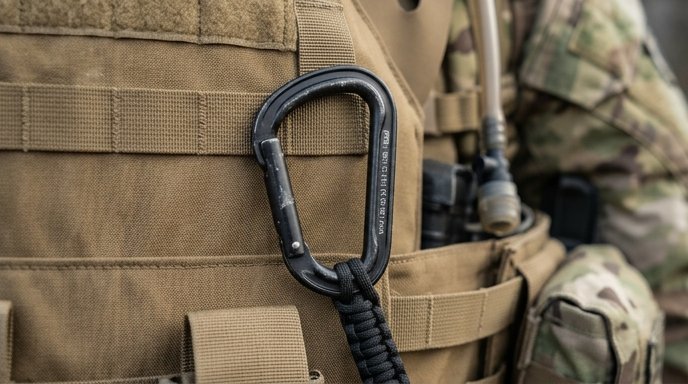
The “Tactical” Label — Spec Category or Marketing Spray-Paint?
There is no official standard that defines a “tactical” carabiner. The word is a description, not a specification: a utility carabiner intended for military, LEO or duty use, usually identified by a non-reflective coating, snag-resistant geometry and a kN rating stamped somewhere on the spine.
Climbing hardware answers to the UIAA. Tactical gear answers to nobody in particular. The DoD does not maintain a specific MIL-STD for carabiners as a category. Procurement is COTS — commercial off-the-shelf hardware that already meets civilian rescue standards, assigned an NSN for inventory purposes. NSN 8465-01-560-1317, for example, is a standard non-locking utility carabiner used for general attachment.
Because the word is unregulated, the market is drowning in cast-zinc clips painted black and shelved next to actual duty kit. A carabiner only earns the label when the engineering backs it up: IR signature reduction, quiet operation, verified multi-axis ratings.
The Four Hardware Traits That Earn the Label Honestly
Four engineering choices separate duty-grade from keychain junk.
Finish. Bright anodized colors reflect light and have a high IR signature. Duty hardware uses Type III hard-coat anodizing, black oxide or Cerakote. Matte, non-reflective, and reasonably good at resisting galvanic corrosion when it eats salt water or sweat all week.
Multi-axis strength. A real duty carabiner is rated in three directions: major axis end-to-end, minor axis cross-loaded, and open-gate. All three numbers matter, and I’ll get into why in Section 5.
Nose geometry. Tactical carabiners use a keylock or shrouded nose. The old pin-and-notch gates snag on 550 cord, tubular nylon, MOLLE webbing, your sleeve, whatever’s handy. A keylock nose is smooth on the inside and comes off clean under speed.
Material. Load-bearing carabiners are hot-forged from 7075-T6 aluminum or machined from marine-grade stainless. Forging aligns the grain structure and gives you the yield strength the spec sheet promises. The clones are cast — molten metal poured into a mold — which produces a brittle part that can let go with no visible warning. There is no shortcut around this. You can anodize a cast carabiner black and sell it for $4, but the metallurgy underneath doesn’t change.
| Feature | Tactical-Grade | Hardware-Store Clone | Climbing-Grade |
|---|---|---|---|
| Material | Hot-forged 7075-T6 or Steel | Cast zinc or cheap aluminum | Hot-forged 7075-T6 |
| Finish | Matte black, Type III anodized | Painted black (chips easily) | Brightly colored anodized |
| Major Axis Strength | 20 kN to 40+ kN | Unrated (or vague “100 lbs”) | 20 kN to 25 kN |
| Nose Design | Keylock / Snag-free | Pin and notch | Keylock or wiregate |
Certifications That Separate Real From Theatrical
Three certifications matter: NFPA 1983, EN 362, UIAA 121. “Mil-spec” on its own, without a MIL-STD or MIL-DTL number attached, is marketing noise.
NFPA 1983 (now consolidated into NFPA 2500). The North American standard for life-safety rope and hardware for emergency services. Two load tiers for carabiners: “Technical Use” (formerly Light Use) at a minimum 27 kN (6,069 lbf) major axis, and “General Use” at 40 kN (8,992 lbf). If the carabiner is meant for rescue or heavy rigging, you’ll see the NFPA stamp on the spine.
EN 362. The European standard for personal fall-protection connectors. Minimum 20 kN major axis. Classified by shape and function: Class B (Basic), Class M (Multi-use), Class T (Termination/Directional), among others. CE EN 362 on the spine means it passed independent lab testing for industrial fall arrest.
UIAA 121. Global mountaineering standard. 20 kN major, 7 kN minor, 7 kN open-gate. Designed for climbing but a lot of tactical carabiners carry it as a baseline proof of life-safety capability.
No stamps, no life-safety use. It’s a utility clip. You don’t rappel on it, you don’t rig fall arrest with it, you don’t put human weight on it.
Where Carabiners Actually Appear in Issued Kit
In real load-bearing systems, carabiners show up in a handful of specific jobs, split roughly between life-safety and utility retention.
- Helicopter retention and lanyards (life-safety). Operators clip into airframes with heavy locking carabiners. The Kong Tango, a directional connector rated to 33 kN, gets issued for this a lot.
- Working dog leashes (high-load utility). MWD handlers need serious hardware. A lunging Malinois generates dynamic loads that will embarrass a cheap carabiner in a hurry. The r/tacticalgear threads are full of handlers who learned this the hard way and ended up buying climbing-rated clips to replace the cast junk that came with the leash.
- Fast-rope insertion (life-safety). Heavy steel carabiners, often 40+ kN General Use, rig the rope to the hardpoint. Aluminum doesn’t live here — the friction and heat eat it.
- MOLLE attachment (low-load utility). Gloves, chem-lights, hydration tubes. The ITW Nexus GrimLoc is the standard polymer D-ring. It’s engineered to break at roughly 80 lbs, which is a feature, not a defect. The whole point is that it lets go before a snagged pouch drags you under a vehicle.
Failure Modes You Won’t See on the Packaging
Understanding how carabiners fail is the fastest way to see why the unrated clones are a bad bet.
Gate flutter. Under heavy vibration — rotor wash, fast-rope deployment, a dynamic drop — the mass of the gate can overcome its spring tension. The gate opens and closes rapidly on its own. Load the carabiner during that window and its strength collapses to its open-gate rating. A Petzl Am’D rated 27 kN closed will go at 7 kN open. That’s not a small gap.
Cross-loading. Carabiners want weight along the spine. Rotate one so the load crosses the gate and the back, and the rating falls off a cliff. A 20 kN carabiner typically holds 7 to 9 kN cross-loaded, which is why directional connectors like the Tango exist.
Fatigue cracking. Cast aluminum carries microscopic voids and inconsistent grain. Cycle it enough and those turn into cracks. Forged 7075-T6 will bend and deform before it goes. Cast aluminum just shatters.
Buying Checklist — Separating Duty Gear From Dress-Up
Ignore the packaging. Look at the metal.
Red flags:
- No kN rating stamped on the spine.
- “Mil-Spec” on the packaging with no MIL-STD number or NSN behind it.
- Painted finish that chips off under a fingernail. That’s paint, not hard-coat anodizing, and it tells you what else got shortcut.
- Visible seam lines along the outer edge — a dead giveaway it was cast, not forged.
Green flags:
- A full 3-axis rating stamped into the spine (e.g., ↔ 27 kN, ↕ 8 kN, ⤡ 7 kN).
- Published certifications (CE EN 362, NFPA 1983, UIAA 121) on the manufacturer’s spec sheet, not just the box.
- Traceable lot or serial numbers laser-engraved on the frame.
- Made by a company whose main business is life-safety hardware. Petzl, SMC, DMM, Black Diamond, Kong. You know the names.
When “Not Tactical” Is the Right Answer
For most EDC, a tactical carabiner is overkill. A climbing-rated or industrial carabiner does the same job at a lower price, unless you specifically need the non-reflective finish or the duty cert.
Keys on a belt loop, Nalgene on a pack strap, compressing a stuff sack — paying the premium for a black-oxide NFPA-rated clip is a waste. A Black Diamond Neutrino weighs 36 grams, costs under $10, and gives you 22 kN of verified breaking strength. That’s more than most people will ever need in a lifetime of hanging water bottles off things.
The tactical label earns its keep in three situations: OPSEC that actually requires a non-reflective finish, duty regs that mandate EN 362 or NFPA 1983, or environments corrosive enough that Type III hard anodizing is doing real work. Outside those, a standard climbing carabiner is smarter, safer and cheaper. I still reach for an old orange Neutrino on my own pack most days, which probably says something about either my judgment or the industry’s.
FAQ
Are tactical carabiners safe for climbing or rappelling?
Only if they carry a UIAA 121, EN 362, or NFPA 1983 cert stamped on the spine. “Tactical” without a kN rating and a recognized life-safety mark is a utility clip. It will fail under body weight in a dynamic fall.
What does “mil-spec” actually mean on a carabiner?
On consumer packaging, nothing. There is no specific MIL-STD for carabiners. The carabiners that actually get issued are commercial climbing or rescue carabiners that got assigned an NSN for procurement. The hardware didn’t change. A number got added to a database. Anybody printing “mil-spec” on a blister pack without a MIL-STD or MIL-DTL designator behind it is counting on you not to ask.
Why are tactical carabiners black?
To reduce IR signature under NODs and kill the light reflection that gives away position. The finish usually improves corrosion resistance against sweat and salt water as a bonus.
What kN rating should I look for in a duty carabiner?
20 kN major axis is the floor. For technical rescue, NFPA Technical Use at 27 kN. General Use is 40 kN.