TL;DR: “Military-grade” isn’t a certification. It usually means a carabiner that’s been assigned a National Stock Number or meets a civilian life-safety standard the DoD happens to buy against. The honest shorthand: 25+ kN major axis, auto-locking gate, forged body, MIL-A-8625 Type III anodizing. Without an accompanying NFPA or UIAA rating, the label is marketing.
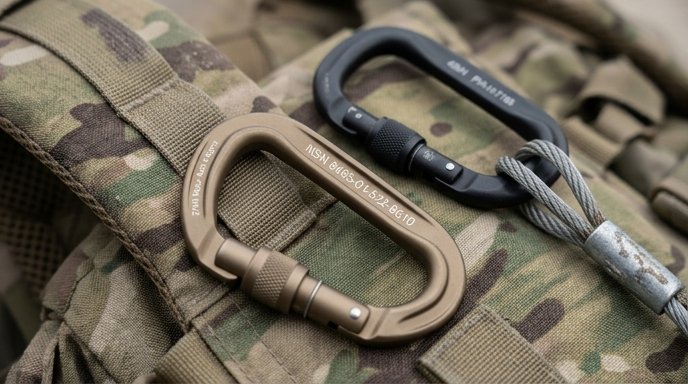
What “Military-Grade” Actually Means on a Carabiner Label
There is no single MIL-SPEC standard for carabiners. When a manufacturer stamps “military-grade” on the spine, that’s a marketing choice, not a regulatory one. The DoD rarely drafts ground-up specs for climbing hardware anymore. They buy Commercial Off-The-Shelf gear that already meets civilian life-safety standards, assign it an NSN, and move on.
The closest thing to a dedicated military standard is the Parachute Industry Association’s hardware specs, like PIA-H-7195 for parachute links. For ground troops, SAR, and SOF, the military assigns a National Stock Number to existing civilian carabiners that pass their procurement filters. No NSN, no recognized civilian life-safety rating? Then “military-grade” means nothing on that label.
| Marketing Claim | What to Look For | Red Flag |
|---|---|---|
| “Military-Grade Strength” | UIAA 121, EN 362, or NFPA 2500 certification | No kN rating stamped on the spine |
| “Tactical Coating” | MIL-A-8625 Type III Hardcoat Anodizing | Painted finishes that chip easily |
| “Issue Gear” | A 13-digit NSN (e.g., 8465-01-114-3950) | “Designed for military use” with no NSN |
The Spec Sheet Decoded — Reading a Carabiner Like a Procurement Officer
A tactical carabiner spec sheet contains specific numbers that dictate its operational limits. Procurement officers ignore the marketing copy and go straight to Minimum Breaking Strength and Working Load Limit.
MBS is the exact force required to break the carabiner under lab conditions, measured in kilonewtons (1 kN = 224.8 lbf). WLL is what the carabiner should actually see in daily use. To get from MBS to WLL you apply a safety factor, and for life-safety work the military and most rescue organizations use 10:1. So a carabiner with a 40 kN MBS (8,992 lbs) has a human-load WLL of 4 kN, or about 899 lbs.
- Major Axis Strength: End-to-end breaking strength. Look for 27 kN to 40 kN.
- Minor Axis Strength: Across the gate. Usually 7 kN to 16 kN.
- Gate-Open Strength: The number if the gate fails to close — often 7 kN to 9 kN.
- Proof Load: A factory pull to 50% of MBS before the unit is packaged.
- Gate Opening: Clearance in mm. 22mm is common. This is what dictates whether your rope, rail, or anchor plate actually fits.
Materials — Why 7075-T6 Isn’t Always the Right Answer
Most tactical carabiners are forged from 7075-T6 aluminum. It’s an aerospace alloy with a yield strength around 73,000 psi (503 MPa), and the strength-to-weight ratio is why the industry defaults to it. A typical 7075-T6 carabiner comes in around 80 grams and holds 27 kN.
Aluminum is not the default everywhere, though. Aviation hoist operators and maritime boarding teams spec steel. Heat-treated 4130 chromoly or stainless pushes major-axis ratings past 45 kN, and steel shrugs off the abrasive wear from cables and ascenders that would chew through an aluminum basket in a few weeks of hard use. I still spec steel for most hoist work out of habit, even on jobs where a good aluminum model would probably hold up fine — call it bias, I don’t entirely trust aluminum against a steel cable.
| Material | Yield Strength | Weight (Avg) | Corrosion Resistance | Best Military Use |
|---|---|---|---|---|
| 7075-T6 Aluminum | ~73,000 psi | 80g | High (if anodized) | Infantry EDC, light rigging |
| 4130 Steel | ~97,000 psi | 250g | Low (needs coating) | Hoist operations, heavy rigging |
| Stainless Steel | ~40,000 psi | 230g | Very High | Maritime operations |
| Titanium | ~120,000 psi | 60g | Very High | Niche SOF applications |
Gate Mechanisms Under Combat and Cold-Weather Conditions
A carabiner is only as strong as its gate, and in the field gates fail from environmental ingress long before they fail from load. Screw-gates freeze shut when moisture gets into the threads and the temp drops. Anyone who’s done a winter exercise has seen it.
Auto-locking gates — twist-lock or triple-action — fix the problem of operators forgetting to lock up under stress. The trade-off is that the more mechanical stages you add, the more surfaces fine sand and mud can jam. Triple-actions are the worst offenders in fesh-fesh.
- Screw-Lock: Best for freezing rain and ice. Threads can be forced open with pliers if frozen.
- Twist-Lock (2-stage): Fast one-handed operation. Prone to accidental opening if rubbed against webbing.
- Triple-Action (3-stage): Required by ANSI Z359.12 for fall protection. Secure, but a pain with heavy winter gloves.
Finishes, Coatings, and Why Everything Looks Black
Military carabiners are black, OD, or FDE to kill IR signature and visible glint. Bare aluminum reflects light and lights up under NODs.
The standard finish on an aluminum tactical carabiner is MIL-A-8625 Type III hardcoat anodizing. Type II, which is what you find on most civilian climbing gear, is largely cosmetic — it adds color and a little corrosion resistance and that’s about it. Type III is different. It builds a 0.002-inch aluminum oxide layer that both penetrates the base metal and grows on the surface, which is where the abrasion resistance comes from. If you’ve ever worn through the finish on a civilian biner in a season of rope work and wondered why issue hardware looks newer after three years of field use, Type III is the answer. It’s also why you can’t easily re-dye a hardcoat-anodized carabiner the way you can a Type II piece — the pore structure is tighter and the dye uptake is poor.
For maritime units, carabiners have to survive ASTM B117 salt-fog testing. Exact hour requirements vary by contract, but anecdotally the baseline for marine aluminum hardware tends to sit in the 300-plus hour range without functional degradation. Steel carabiners usually get zinc-phosphate or Cerakote to keep the rust off.
Life-Safety vs Utility — The Rating That Can Kill You
If a carabiner doesn’t list one of four standards — NFPA 2500 (formerly 1983), ANSI Z359.12, UIAA 121, or EN 362 — don’t clip it to a human.
The military fields thousands of utility carabiners. They secure gear in vehicles, hang rucks, manage canine leashes. A utility clip might hold 5 kN (1,100 lbs) and look identical to life-safety hardware on the shelf, but there’s no proof-testing and no quality control traceability behind it. That’s the whole difference, and it’s invisible until it isn’t.
For life-safety, NFPA is the benchmark in US rescue and military rope access. Under NFPA 2500, carabiners split into two categories:
- Technical Use (T): Minimum major axis strength of 27 kN (6,069 lbf).
- General Use (G): Minimum major axis strength of 40 kN (8,992 lbf).
ANSI Z359.12 adds another requirement for fall protection: the gate itself has to withstand 3,600 lbs (16 kN) of force from the inside out, to prevent rollout under a side-load.
NSN-Listed Carabiners and How to Actually Buy One
A National Stock Number means the Defense Logistics Agency has vetted the item, assigned a 13-digit code, and made it orderable through unit supply. Civilians can buy the exact same models, as long as they know the manufacturer part number tied to the NSN.
- Identify the NSN. NSN 8465-01-114-3950 is a widely-issued basic snap link.
- Cross-reference the manufacturer. PartTarget or GSA Advantage will tell you who holds the current contract — historically SMC, Petzl, or Omega Pacific.
- Buy commercial. Same hardware. You’re just skipping the DoD routing paperwork.
The thing people miss here is that NSN assignment isn’t a quality endorsement in the engineering sense. It’s a procurement convenience. A piece gets an NSN because somebody wrote a solicitation, a vendor bid, and the contract got awarded. The underlying hardware is whatever the vendor was already making.
Field-Proven Models and What Their Spec Sheets Reveal
Comparing issued hardware shows what specs actually matter. The models below either hold active NSNs or show up in SOF breacher and rescue kits.
| Model | Major Axis | Minor Axis | Material | Gate Type | Standards |
|---|---|---|---|---|---|
| Petzl Vulcan | 45 kN | 16 kN | Steel | Tri-Act | NFPA (G), ANSI, CE |
| SMC Lite Alloy | 27 kN | 7 kN | 7075-T6 | Screw | NFPA (T) |
| DMM Rhino | 27 kN | 9 kN | Aluminum | Auto-lock | EN 362 |
| Kong Tango | 33 kN | 10 kN | Aluminum | Double-gate | CE EN 362 |
The Vulcan is the heavy end — 45 kN, built for rescue loads and steel cables. The SMC Lite Alloy is the tactical baseline: exactly 27 kN to meet NFPA Technical Use, 74 grams on the scale. The DMM Rhino’s horn-shape minor axis is doing something specific that most people clipping one into a harness have never thought about.
FAQ
Is “military-grade” a real certification for carabiners?
No. It’s marketing. Real military carabiners are identified by an NSN or by meeting civilian life-safety standards — NFPA 2500, ANSI Z359.12, UIAA 121.
What kN rating do military carabiners need to be?
For life-safety and rope access, the floor is 27 kN (6,069 lbs) for NFPA Technical Use. General Use rescue work bumps that to 40 kN.
Can I use a military utility carabiner for climbing or rappelling?
No. Utility carabiners don’t go through proof-loading, don’t carry a certified minor-axis rating, and have no traceability on the materials. They exist to hang gear off a ruck, not to catch a human.
Why do military carabiners cost more than hardware-store ones?
Individual proof-loading at the factory (pulled to 50% of MBS before it ever leaves the line), MIL-A-8625 Type III hardcoat anodizing instead of a decorative finish, and third-party certification fees from UL, CE, or NFPA. The certification paperwork alone is a real cost center for the manufacturer, and it gets passed on. A hardware-store snap link skips every one of those steps.