TL;DR: 7075 aluminum is roughly 80% stronger than 6061, which is why almost every certified climbing carabiner uses 7075 and almost every utility or keychain carabiner uses 6061. 7075-T6 runs 572 MPa UTS versus 310 MPa for 6061-T6. The catch: 6061 resists stress corrosion cracking better, and it’s a fraction of the cost.
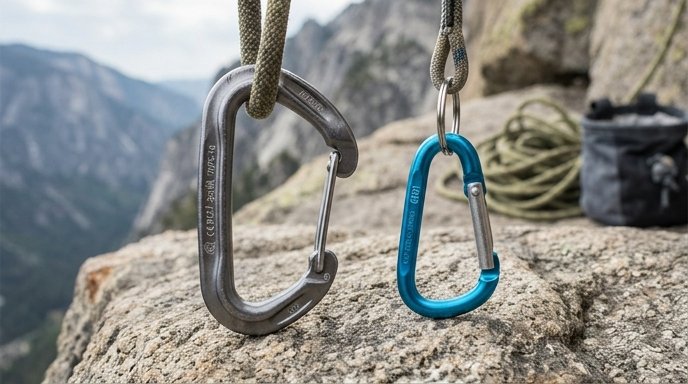
The Short Answer: Which Alloy, Which Carabiner
Manufacturers split aluminum alloys along a pretty hard line. Life-safety gear needs the best possible strength-to-weight. Accessory hardware needs to be cheap and to not rust in your junk drawer. Those two priorities don’t overlap much.
Petzl, Black Diamond, and DMM all forge their load-bearing climbing carabiners from 7075. The high zinc content is what lets these companies build a biner that weighs under 30 grams and still holds 20 kN (roughly 4,500 lbs).
Brands making accessory clips (Nite Ize is the obvious example) use 6061 or 6063 instead. Cheaper to extrude, cheaper to machine, holds up fine to weather. It’ll also fold under your body weight if you clip into the wrong one, which is a problem we’ll get to.
| Use Case | Recommended Alloy | Why |
|---|---|---|
| Rock Climbing / Alpinism | 7075-T6 | Max strength-to-weight; meets UIAA 20 kN. |
| Arborist / Rescue | 7075-T6 (or Steel) | Handles rigging loads and drop shock. |
| Hammock Camping | 7075-T6 | Light enough to pack, strong enough for static body weight. |
| Keys / Water Bottles | 6061-T6 | Cheap, corrosion-resistant, easy to mass-produce. |
| DIY / Prop Making | 6061-T6 | Machines well, welds well, available in any stock size. |
Mechanical Properties That Actually Matter for a Carabiner
When you line up 7075-T6 against 6061-T6, the baseline numbers explain the industry split pretty cleanly. 7075-T6 runs an Ultimate Tensile Strength of 572 MPa with a yield of 503 MPa. 6061-T6 sits at 310 MPa UTS and 276 MPa yield. On raw strength it’s not close.
Tensile numbers only cover one failure mode, though. Carabiners see weird loading geometries (cross-loading, nose-hooked, tri-axial loads from a bad clip) and that’s where elongation at break starts to matter. Elongation is how much the material stretches before it snaps. 6061-T6 gives you 12–17%. 7075-T6 gives you about 11%.
That lower elongation means 7075 is more brittle. Push a 7075 biner past its max load and it tends to snap without warning. A 6061 piece will usually bend and deform first. Gear designers compensate for 7075’s brittleness by over-building the spine geometry so the biner never actually reaches its yield point under normal use. In practice this works. You almost never hear about a modern climbing carabiner failing from a straight tensile overload. The failures that do happen are almost always gate-open, cross-loaded, or (the one everyone ignores) corrosion-driven.
| Property | 7075-T6 | 6061-T6 | 7075-T73 |
|---|---|---|---|
| Ultimate Tensile Strength | 572 MPa | 310 MPa | 505 MPa |
| Yield Strength | 503 MPa | 276 MPa | 434 MPa |
| Elongation at Break | 11% | 12-17% | 13% |
| Young’s Modulus | 71.7 GPa | 68.9 GPa | 72.0 GPa |
Where Strength Numbers Lie — Fatigue Under Repeated Clipping
A sport quickdraw sees thousands of small load cycles from rope drag, clipping, unclipping, short falls, lowering. Tensile strength only tells you about a single catastrophic pull. Fatigue strength tells you how long the thing survives in the real world.
At 500 million cycles, 7075-T6 has a fatigue limit around 159 MPa. 6061-T6 sits at roughly 96.5 MPa. On absolute numbers, 7075 wins again, but 6061 actually performs slightly better in proportional terms. The endurance ratio (fatigue limit divided by UTS) is 0.31 for 6061 and 0.27 for 7075. So 6061 keeps a higher percentage of its baseline strength under cyclic loading.
That proportional advantage doesn’t matter for climbing, though, because 7075’s absolute fatigue limit still comfortably outruns the cyclic stresses a rope can generate.
The Corrosion Problem Nobody Mentions in Gear Reviews
Here’s where things get interesting, and where I’d argue most consumer gear reviewers are asleep at the wheel.
7075-T6 is substantially more prone to stress corrosion cracking than 6061, especially in chloride environments. Coastal air. Sweat. The inside of a chalk bag that lives in a damp pack. The same zinc and magnesium that give 7075 its strength also set up microscopic galvanic cells inside the grain structure. When a 7075 biner sits under residual stress (a tight gate spring pin is a classic one) in a chloride environment, micro-cracks can start propagating into the spine. Not immediately. Not visibly. But they’re happening.
Climbers who project at Kalymnos or on UK sea cliffs report this stuff anecdotally all the time: pitting, white oxidation, a weird dullness to the anodizing. I’ve seen biners come off a sea-cliff rack after a season looking a decade older than their actual age.
Manufacturers can shut most of this down by using the T73 temper. Over-aging the alloy to T73 kills SCC susceptibility almost completely, but you pay for it: UTS drops from 572 MPa to 505 MPa. Almost nobody in the climbing industry takes that trade. The weight penalty would be too obvious on the shelf. Instead they stick with T6 and rely on anodizing as a barrier layer.
Which brings up another small tell. 7075 anodizes less uniformly than 6061 because the high zinc content interferes with the electrochemical dye process. That’s why your climbing biners tend to have a slightly matte or muddy color finish, while a 6061 keychain clip comes out glossy and vivid. If you’ve ever wondered why climbing hardware looks “cheaper” than a $4 Nite Ize, that’s actually why. It’s not cheaper. It’s a harder alloy to finish.
Why 7075 Dominates Certified Climbing Gear
7075’s grip on life-safety gear comes down to the standards. EN 12275 and UIAA 121 both say a standard climbing carabiner has to hold at least 20 kN on the major axis, 7 kN on the minor axis, and 7 kN with the gate open.
Hitting 20 kN with 6061 is possible, but you’d need thick, heavy bar stock. A standard rack carries 12 to 14 quickdraws, so the climber is lugging 24 to 28 biners up the wall. If you built those out of 6061 to meet the 20 kN standard, each one would weigh something like 60 to 70 grams. With 7075, companies like Black Diamond and Petzl deliver the same rating at 23 to 35 grams.
Then there’s liability. Sell a carabiner for climbing, have one fail, and the legal exposure is massive. 7075 costs more per kilo and burns through tooling faster, but gear companies eat those manufacturing costs because 7075 is the only way to hit UIAA numbers at a weight the market will actually buy.
Why 6061 Dominates Everything Else
If a carabiner isn’t rated for climbing, it’s almost certainly 6061 or 6063. 6061 extrudes beautifully, machines cleanly, and costs a lot less per kilo than 7075.
The other quiet advantage for 6061 in industrial work is weldability. It welds cleanly with standard TIG using 4043 filler. 7075 is effectively unweldable for structural purposes (the heat causes microcracking and nukes the T6 temper), which is why you never see welded 7075 assemblies in rigging catalogs.
This all creates a dangerous visual ambiguity. A 6061 utility carabiner from a hardware store can look almost identical to a 7075 climbing biner. But because 6061 yields at 276 MPa, a standard-sized utility clip usually bends and fails somewhere between 2 and 4 kN (450 to 900 lbs). This is why manufacturers stamp “NOT FOR CLIMBING” on the spine. The alloy simply cannot hold dynamic fall loads in a standard carabiner geometry, and no amount of over-building a 6061 clip in a $3 retail package is going to change that.
Manufacturing Differences — Forged, Machined, and Why It Changes the Alloy Choice
Carabiners are not cast. Casting introduces voids and unpredictable weak points, so nobody serious does it. They’re forged, and the alloy dictates which forging method you use.
Climbing brands hot-forge 7075. Rod stock gets heated to roughly 400°C (industry-standard range for 7xxx series) and pressed into a die. Hot forging aligns the internal grain flow along the spine of the carabiner, which maximizes strength along the major axis exactly where it needs to be. The process also lets designers push metal around in three dimensions, moving mass out of low-stress zones like the basket and concentrating it where loads actually land.
Utility biners made from 6061 are cold-forged or just bent from extruded wire stock. 6061 is soft enough in its annealed state to shape at room temperature, then heat-treated to T6 afterward. Cold forging is dramatically cheaper than hot forging, which is how you end up with a retail biner under five bucks.
Choosing for a Custom Project
For hardware designers, prop makers, and DIY folks building their own clips or bag hardware, 6061-T6 is the right pick. It’s not even close.
Finding 7075 stock in small quantities is painful and expensive. Machining it requires rigid setups and sharp carbide, and if you try to weld a custom 7075 assembly the joint will crack as it cools. 6061-T6 machines predictably, takes anodizing in a wide range of colors, and welds cleanly to other 6000-series components.
Safety Warning: Do not fabricate your own aluminum hardware for life-safety applications, climbing, or aerial rigging. Certified carabiners go through non-destructive testing (eddy current scanning, proof-loading) that you cannot replicate in a home shop. Full stop.
Frequently Asked Questions
Is 7075 aluminum always stronger than 6061?
Yes, on tensile and yield numbers. 7075-T6 runs about 572 MPa UTS, roughly 80% stronger than 6061-T6 at 310 MPa. 6061 is more ductile and more resistant to stress corrosion cracking, though, so “stronger” isn’t the whole story.
Can a 6061 aluminum carabiner be used for climbing?
No.
Why do 7075 carabiners sometimes crack without being overloaded?
7075-T6 is susceptible to stress corrosion cracking (SCC). When the alloy sits under mechanical stress in a chloride environment (salt air, heavy sweat, humid coastal climates), microscopic galvanic cells form between the zinc and magnesium phases in the grain structure, and cracks propagate slowly from there. The biner may still look fine on the outside while the spine is quietly compromised. This is the main reason climbers in marine environments retire 7075 gear earlier than inland climbers do, even without visible damage or logged falls.
How can I tell what alloy my carabiner is made of?
Look at the spine. A kN rating and a CE/UIAA stamp means it’s almost certainly 7075. No rating, or a “Not for climbing” stamp, means 6061 or 6063.