TL;DR: Choosing a carabiner manufacturer comes down to three things: certification scope (UIAA/EN/ANSI vs. novelty-only), forging capability (hot-forged for load-bearing, stamped for keychains), and factory legitimacy (real production vs. trading intermediary). Verify with lot-level proof-load records, not generic certificates.
First, Classify Your Carabiner — Not All Suppliers Can Legally Make Yours
Before you contact anyone, classify your product’s end use. The legal and manufacturing requirements for a keychain accessory share almost zero overlap with life-safety hardware, and treating them as a spectrum is how importers end up on recall lists.
If your carabiner is intended for climbing, it falls under EN 12275 in Europe, which requires a minimum major axis strength of 20 kN for basic (Type B) connectors. Industrial fall-arrest applications require EN 362 in the EU and ANSI Z359.12 in the United States. The ANSI standard is particularly strict, mandating a 3,600 lb (16 kN) gate strength to prevent rollout during a fall.
Under EU PPE Regulation 2016/425, any carabiner designed to protect against falls from height is Category III PPE — life-saving equipment. Selling an uncertified “climbing-style” carabiner for load-bearing use violates this regulation and exposes the importer to legal penalties and mandatory recalls. If your product is a novelty item, it needs to be physically incapable of being confused with climbing gear, or explicitly marked “Not for climbing.” That marking alone won’t save you if the shape and kN stamp suggest otherwise, but it’s the baseline.
Factory vs. Trader — The 7 Questions That Expose Middlemen
A carabiner trading company is an intermediary that resells factory output. A true manufacturer owns the forging dies, the heat-treatment line, and the QC lab on-site. Trading companies typically add 15% to 30% markup and obscure the actual origin of your goods, which makes batch traceability basically impossible when something goes wrong.
To separate real factories from middlemen, ask these during initial vetting:
- “Can we schedule a live WeChat or Zoom tour of your forging presses and heat-treatment ovens tomorrow?” Traders will produce excuses about factory rules.
- Send me your ISO 9001 certificate. Then check whether the scope says “manufacturing” or just “sales/export.”
- Who owns the forging dies if I pay the tooling fee?
- Can you provide a recent Mill Test Report for your 7075 aluminum stock?
- Does the company name on your business license match the name on your Alibaba profile and your bank account exactly?
- What is your physical address? Search it. Traders often list single room numbers in large commercial office towers, not industrial parks.
- Can you show me your in-house tensile tester on the video call?
| Feature | True Manufacturer | Trading Company |
|---|---|---|
| Pricing | Base factory rate | 15–30% markup |
| Tooling | Modifies dies in-house | Outsources all custom shapes |
| Traceability | Lot-level test data | Generic product certificates |
| Location | Industrial zone, large footprint | Office building, single suite |
Question 5 catches more fakes than the other six combined. I don’t know why, but it does.
Forging, Stamping, or Casting? The Process Dictates the Price Floor
Manufacturing process sets the physical ceiling for what the carabiner can ever be. Hot forging is the standard for load-bearing aluminum carabiners: heating the aluminum before pressing it into a die aligns the metal’s grain structure, which is what lets you hit 20+ kN while shaving material with I-beam spines and similar weight-saving geometry.
Cold forging is used for simpler shapes, typically steel carabiners. Strong, but less design flexibility. CNC machining cuts carabiners from solid billet — strong, but it wastes material and runs too slow and expensive for mass production. Stamping punches flat shapes out of sheet, which is fine for keychains and other low-load accessories and nothing more.
Then there’s die-casting. Molten zinc alloy (usually Zamak) forced into a mold. Die-cast carabiners are brittle, prone to hidden internal air voids, and have roughly half the tensile strength of forged aluminum. They cannot pass EN 12275. If someone tries to sell you die-cast hardware for anything load-bearing with a kN rating painted on the spine, the rating is a lie and the liability is yours.
Certifications That Matter — and the Paperwork That Proves Them
Climbing and fall-arrest carabiners sold in the EU require CE Category III certification under PPE Regulation 2016/425. In the US, ANSI Z359.12 covers industrial use. Buyers routinely confuse a product test report with full certification, and suppliers routinely exploit that confusion.
A legitimate CE Category III certification requires two distinct modules. Module B is the EU Type Examination, where a notified body tests the physical design. Module D (or Module C2) is the ongoing quality assurance of the production process, with annual factory audits. A supplier handing you a single lab test report from five years ago is not certified. They are showing you half the paperwork and hoping you don’t notice.
Verify by checking the four-digit Notified Body number next to the CE mark. Credible notified bodies for PPE include SATRA (NB 2777), TÜV SÜD (NB 0123), and VVUÚ (NB 1019). Look the number up in the EU’s NANDO database to confirm the lab is actually authorized to test PPE. If the factory cannot produce both a Module B certificate and a valid Module D audit report, walk away. There is no version of this where you push past that gap and the shipment is fine.
Material Grades — When “Aircraft Aluminum” Is Marketing and When It’s Spec
“Aircraft aluminum” is a marketing phrase that hides the actual alloy grade. Load-bearing aluminum carabiners require 7075-T6, which uses zinc as its primary alloying element and reaches a tensile yield strength around 503 MPa.
Cheaper suppliers will substitute 6061-T6. It’s corrosion-resistant and easy to machine, but its yield strength is roughly 276 MPa — nearly half. A 6061 carabiner has to be noticeably thicker and heavier to hit the same 20 kN rating, and if your supplier’s “7075” carabiner feels suspiciously light compared to the samples the serious factories sent you, that’s your tell.
For steel carabiners, carbon steel with zinc electroplating is standard for indoor or dry industrial use. For marine or highly corrosive environments, specify 316L stainless. The molybdenum content in 316L prevents the pitting corrosion that eats 304 stainless when it hits saltwater. Always demand a Mill Test Report with your shipments to verify the chemical composition of the raw material batch — not a generic alloy datasheet, the actual MTR tied to your lot. I still spec 316L for freshwater lake applications even though 304 would hold up fine. Old habit from a bad batch years ago, not strictly justified.
Realistic MOQ, Tooling, Lead Time, and Unit-Cost Benchmarks
Custom carabiner manufacturing needs upfront investment in steel forging dies. Tooling for a custom hot-forged aluminum shape typically runs $800 to $2,500, depending on the 3D profile complexity and gate mechanism.
Because setting up the press takes real time, MOQs for custom shapes usually start between 1,000 and 3,000 units. If you only want custom laser-engraved branding on an existing open-mold design, MOQs drop to 300–500 units with no tooling fee.
Lead times generally follow a 10-week pattern: 3 to 4 weeks to cut tooling and produce first-article samples, then 4 to 6 weeks for mass production, heat treatment, anodizing, and assembly. Pricing is harder to pin down. Ballpark, a standard 7075-T6 wire-gate climbing carabiner has historically landed somewhere between $2.50 and $4.00 FOB, with complex auto-locking industrial steel connectors in the $6.00 to $12.00 FOB range. Current spot pricing on aluminum moves these numbers around month to month, so treat anything you read (including this) as a starting reference, not a quote.
Quality Control You Should Demand Per Shipment (Not Just Per Order)
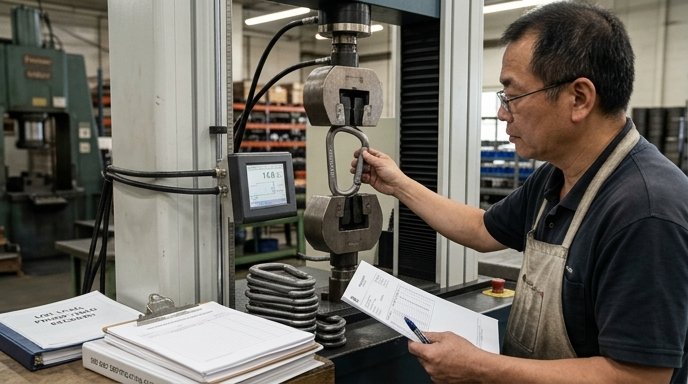
QC for life-safety hardware has to happen at the lot level, every lot, not just the first production run. UIAA 121 requires climbing carabiners to be proof-loaded to 50% of their rated minimum breaking strength, or at least 10 kN, before leaving the factory. This non-destructive test seats the gate and surfaces manufacturing defects that visual inspection won’t catch. If your factory can’t show you proof-load records tied to the batch numbers on your cartons, they either aren’t doing it or aren’t tracking it, and both are disqualifying.
Demand serialized batch traceability. Every carabiner should carry a laser-etched batch number that ties back to a specific heat-treatment run and raw material MTR. For cosmetic and dimensional checks, standard hardware inspections use ISO 2859-1 — specify AQL 1.5 or 2.5 for major defects (sticky gates, sharp edges) and 4.0 for minor cosmetic issues like anodizing scratches.
Hire a third-party inspection agency such as QIMA or SGS for a Pre-Shipment Inspection. The inspector pulls samples randomly from the finished cartons and runs destructive tensile testing on-site using the factory’s calibrated equipment. If the factory suddenly discovers their tensile tester is “being recalibrated” the week of your PSI, draw your own conclusions.
Red Flags That Should Kill a Deal Immediately
Certain supplier behaviors indicate either incompetence or active deception around safety standards. The most obvious is a fake CE mark: the official Conformité Européenne mark has specific proportions, and counterfeiters often use a visually similar “China Export” mark where the C and E sit closer together. Google it once, you’ll recognize it forever.
Kill the deal if a factory offers to lower the unit price by skipping T6 heat treatment. Without it, 7075 stays soft and will fail catastrophically under load. There is no acceptable version of this conversation.
Check the US CPSC and the EU’s Safety Gate (formerly RAPEX) databases before you issue an RFQ. Recent recalls frequently involve uncertified carabiners bundled with backyard zipline kits and hunting tree-stands that snapped under dynamic loads. If a supplier’s company name or a specific product geometry you’re being pitched appears in those recall databases, that’s the end of the vetting process.
Shortlisting and the First RFQ — Template and Scoring Rubric
When you issue your RFQ, score responses with a weighted rubric rather than defaulting to lowest price.
Suggested weighting:
- Certification & Compliance (30%) — valid Module B and D certificates from a recognized notified body
- Process Match (25%) — in-house hot forging and heat treatment
- QC Transparency (20%) — will they agree to third-party AQL inspections and release lot-level proof-load data
- Price (15%) — competitive without being suspiciously low
- Communication (10%) — direct technical answers vs. deflection
Your RFQ should spell out the required material (e.g., 7075-T6), target standard (e.g., EN 12275 Type B), finish (e.g., Type II anodizing), and your third-party inspection terms. Suppliers who ignore those details in the initial quote will ignore them in production.
FAQ
What’s the minimum order quantity for custom carabiners?
For a completely custom shape requiring new forging dies, MOQs typically run 1,000 to 3,000 units. Custom laser-engraved branding on an existing factory design usually drops that to 300–500 units.
How do I verify a carabiner factory’s certifications are real?
Find the four-digit Notified Body number next to the CE mark on the certificate. Look it up in the EU NANDO database to confirm the lab exists and is authorized to test PPE specifically — not just some other product category. Then contact the notified body directly and verify that the specific certificate number is valid and belongs to that factory, not to a parent company, sister company, or former client whose paperwork is being recycled. This last step takes an email and maybe a week of patience, and it is the single highest-leverage thing you can do before placing a serious order. Factories that have real certification will not be offended by the verification request. Factories that fake it will stall, change the subject, or produce increasingly elaborate reasons the notified body is “slow to respond.”
Where are climbing-grade carabiners mostly manufactured?
Taiwan and mainland China. Taiwan historically holds the premium hot-forging reputation, though top-tier mainland factories now produce identical quality for major Western brands.
What’s the difference between a forged and a cast carabiner?
Forging presses solid metal into shape under extreme pressure, aligning grain structure for maximum strength. Casting pours molten metal into a mold, which can leave hidden internal voids and produces a brittle finished part. Cast carabiners should never carry load.
Can I private-label a climbing-rated carabiner with my own branding?
Yes, but you take on the legal liability of the manufacturer. If you sell a CE Category III carabiner under your brand in the EU, you’re responsible for maintaining the technical file and the Module D audits, and your brand must be registered with the notified body.