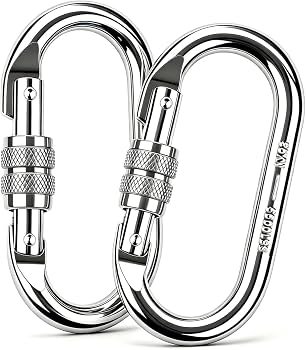
TL;DR
Most carabiner problems (sticky gates, dirt, mild corrosion) are fixable with warm water, a soft brush, and silicone lube. Anything past that, a bent gate, a deformed spine, sharp burrs, a rope groove pushing 1mm, or a hard fall onto rock, and the carabiner is done. You retire it. You don’t file it, weld it, or swap parts on it. That’s the entire framework.
The One Rule That Decides Everything: Load-Bearing vs. Utility
Before you touch anything, figure out what the carabiner is actually for. If it’s used for climbing, arboriculture, rescue, or industrial rope access, it’s life-safety equipment. Those carry a specific certification stamp: EN 12275 (mountaineering) or EN 362 (industrial PPE against falls).
For anything under those standards, “repair” means cleaning and lubrication. That’s it. You can’t swap a gate from an old Petzl Am’D TRIACT-LOCK onto a new body. You can’t heat-treat the aluminum to “fix” a bent spine. Manufacturers are unambiguous about this, and the certification is void the moment you modify the geometry.
Utility carabiners, the ones on dog leashes or holding your keys, are a different conversation. Bend them, file them, drill them, doesn’t matter. Failure means your keys hit the floor.
Diagnosing the Problem in 60 Seconds
Same symptoms, wildly different fixes. Work through this before you decide whether to clean or trash.
| Symptom | Likely Cause | Fixable? |
|---|---|---|
| Gate feels crunchy or slow to snap | Grit in the hinge, dead lube | Yes. Flush and relube. |
| Gate hangs up on the nose or misses the keylock | Bent spine or bent gate wire | No. Retire. |
| Screwgate stops turning halfway | Dirt in the threads | Yes. Clean it. |
| Deep notch in the basket | Rope wear | Depends. Retire past 1mm. |
| White powdery bloom on the aluminum | Surface oxide or chloride exposure | Sometimes. Pitting means retire. |
Per EN 12275, the gate has to snap fully shut on its own and take at least 5 Newtons of force to manually open. If a proper cleaning doesn’t restore that spring behavior, the spring is fatigued. There’s no user-serviceable fix for a dead spring in a modern climbing carabiner. The unit’s dead.
Fixing a Sticky or Slow-Closing Gate
This is the fix you’ll do the most. Nine times out of ten a “broken” carabiner is just a hinge full of chalk dust and grit from a sandy crag.
- Soak and agitate. Lukewarm water, max around 30°C. Drop of pH-neutral dish soap. Submerge the hinge and cycle the gate 30 to 50 times to work the abrasives out of the spring housing.
- Blow out the hinge. Compressed air, straight into the hinge and the locking sleeve. If you don’t have compressed air, a few hard shakes and patience.
- Dry in the shade. Not in direct sun. UV degrades the plastic components in some auto-locking sleeves (the button on a BALL-LOCK, for example) and there’s no reason to accelerate that.
- Lubricate. One drop on the hinge pin, cycle ten times, wipe the exterior.
If it still feels sluggish after all that, it’s not dirt anymore. It’s the spring.
Lubricant Chemistry, What to Use and What to Never Use
Grabbing WD-40 for a sticky gate is the single most common mistake I see, and it’s a chemical one. Standard WD-40 is a water-displacer with a solvent carrier. It’s not a lubricant in any meaningful long-term sense. The carrier evaporates, leaves a slightly tacky residue, and that residue is a magnet for chalk and silica. Your gate will feel great for two pitches and worse than before by pitch four.
Petzl and DMM both specifically call for silicone-based oil. One drop on the hinge pin. Wipe the exterior thoroughly, because oil residue on the outside of a carabiner transfers to your rope, and oil on nylon is a bigger problem than a slow gate.
Cold weather (below -10°C or so) and sandstone environments are the exception. Silicone oil gets thick and grabby in cold, and in sand it holds onto grit. In those cases a PTFE dry lube or a wax-based bike chain lube (White Lightning is the one people mention most on the forums) works better. Dry film, doesn’t hold dust. You reapply more often. Trade-off.
Corrosion, Salt Exposure, and Oxidation
Modern climbing carabiners are forged from 7075 aluminum. Aluminum doesn’t rust the way steel does, but 7075 is susceptible to Stress Corrosion Cracking when it hits chlorides. Seawater, road salt, ammonia. Which, incidentally, is why leaving a carabiner in a pack with a sweaty harness for a week is a genuinely bad idea, not just gross.
Light white powdery bloom on the surface is just aluminum oxide, and it scrubs off with a nylon brush and warm water. If it’s pitted, though, meaning the corrosion has actually eaten into the surface, that’s structural. You can’t polish out a pit. The 20kN major-axis rating assumes intact metal, and a pitted carabiner isn’t intact metal. Destroy it.
Steel carabiners hold up better to this kind of environment, which is why gyms buy them in bulk, though even steel doesn’t love salt air.
The Locking Mechanism Won’t Screw / Twist / Auto-Lock
Different lockers fail differently.
Screwgates. Petzl ATTACHE and similar. If the sleeve is stuck locked, it’s usually because water flushed the internal lube out or someone tightened it while it was weighted (never do this, by the way). Petzl’s own recommendation is to wrap a piece of 1-inch tubular webbing tightly around the sleeve to get real friction and mechanical advantage. Works about 80% of the time. If the threads are cross-threaded or peened flat, it’s over.
Twist-locks and triple-actions. Am’D TRIACT-LOCK, that family. Torsion spring inside. If it needs physical help to rotate back into the locked position, that’s your warning shot. Flush with hot water (near boiling is fine, it dissolves skin oils and sap that silicone won’t touch), blow dry, PTFE dry lube. If it still won’t snap back on its own, the spring is broken and you can’t get inside the sleeve to replace it. Obviously you wouldn’t try to pry one open.
What You Absolutely Cannot Fix
This is the part people want to argue about, and it’s the part that gets people hurt. Retire, don’t repair, if you see any of these:
- Rope grooves over 1mm. Rope running over aluminum saws a channel over hundreds of falls. 1mm is the universal retirement number.
- Sharp burrs on the basket. A hard fall against a bolt hanger can throw up a burr sharp enough to core-shot a rope under load. There’s an ongoing forum argument on Mountain Project about lightly sanding minor burrs on the bolt side of a sport draw, which I’ll leave alone. What isn’t debatable: never file or Dremel the rope-bearing side. Ever.
- Bent gates or spines. If the gate doesn’t line up perfectly with the nose, the metal has yielded. Pliers won’t undo that. The alloy work-hardens and cracks.
- Missing or loose rivets. Loose gate pin means the gate will fail under a minor-axis load.
- Unknown history. Never buy used life-safety gear. I know it’s tempting on Facebook Marketplace. Don’t.
I still spec heavier steel connectors for some anchor applications where aluminum would be fine, honestly, out of habit from tree work more than any real justification. Old habit. Point being: the retirement rules above aren’t preferences, those actually are the line.
Inspection Protocol
IRATA-level rope access work involves documented daily inspections before you leave the ground. Recreational climbers don’t need paperwork, but the tactile parts of that protocol are worth stealing.
- Tactile check. Thumbnail along the inside of the basket. Feel for burrs. Feel for grooves. Your thumbnail catches on things your eyes miss.
- Visual check. Look for hairline cracks around the hinge pin and the nose hook. Make sure the stamps (UIAA, CE, kN ratings, typically something like 20/7/7) are still legible. If you can’t read them, you don’t know what you’re holding.
- Action check. Open the gate fully, release it, listen. It should snap shut with an audible click. Then pull laterally on the closed gate, that’s the cross-loading direction, and make sure the gate doesn’t pop past the nose hook.
Sixty seconds per carabiner. Do it before every crag day.
When to Retire, and How to Get Rid of It
A well-kept carabiner (dry storage, no extreme heat, no big falls) can technically last a decade or more. That’s the metal. The soft goods on quickdraws, the nylon dogbones, have a hard 10-year retirement date regardless of use, which is worth knowing because a lot of people replace the carabiner and keep the dogbone.
When something fails inspection, destroy it. This part matters. An intact-looking carabiner in a dumpster will get pulled out by someone who has no idea it’s compromised. Hacksaw through the spine, or crush the gate in a bench vise. Either works. Municipal recycling usually rejects anodized aluminum anyway, so a dedicated scrap yard is the right destination.
Or, and I do this myself, mark the retired ones with red paint or a heavy scratch through the kN stamp and use them for garage hooks. Non-load-bearing. They’ll hold a coiled extension cord fine.
FAQ
1. Can I use a carabiner after it’s been dropped from height?
Depends on what it fell on and how far. Waist height onto grass, dirt, a foam pad, fine. Ten meters onto rock or concrete, no, and the visible-damage question isn’t relevant. The UIAA Safety Commission has been clear on this for years: aluminum is strain-rate sensitive, which means a high-speed impact against something harder than the aluminum itself can create microfractures that you literally cannot see. Dye penetrant testing or ultrasonic testing can find them. Your eyes can’t. The failure mode is that the carabiner looks perfect, passes your visual inspection, and then breaks at 40% of its rated strength six months later when you take a whipper. That’s the specific reason retire-when-in-doubt is the rule. It’s not overcaution.
2. What lubricant do manufacturers officially recommend?
Silicone oil. Petzl and DMM both call for it explicitly. Avoid WD-40 for the reasons already covered. PTFE dry lube is acceptable in dusty or sandy environments.
3. How long does a carabiner last if I take care of it?
Anywhere from five years to a lifetime. There’s no expiration date on the metal itself. What kills a carabiner is mechanical wear, meaning either the rope has cut a groove deeper than 1mm or the gate spring has fatigued.
4. Is it safe to buy or use a second-hand carabiner?
No. The UIAA is direct about this and so am I. You don’t know if it was dropped, stored next to a car battery, or left in a hot truck bed for two summers in a row. The full history matters and you can’t reconstruct it.