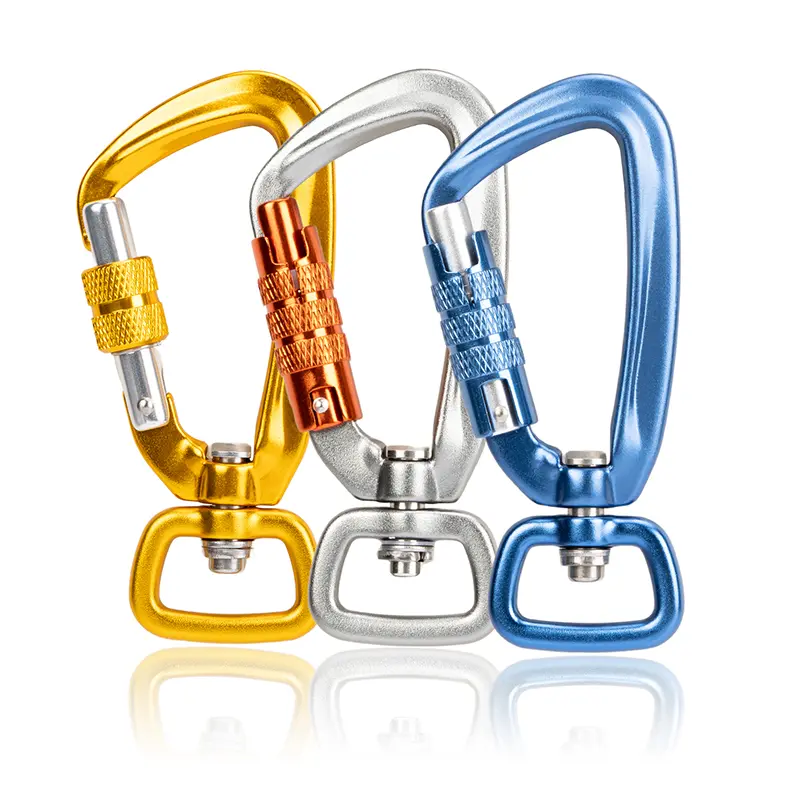
A carabiner’s markings tell you three things: how strong it is (in kN), how it’s certified (CE and UIAA), and when it was made. The three kN numbers on the spine show strength along the major axis, minor axis, and with the gate open, in that order. Learn to read those and most of the guesswork on a used rack disappears.
The Anatomy of a Marked Carabiner (Where to Look)
Manufacturers don’t scatter markings randomly. Laser-etching a load-bearing tool is a compromise, so they put the data on the surfaces least likely to see rope wear or take a hit.
- The spine. The long solid side opposite the gate. This is where the kN numbers, the CE mark, and the UIAA logo live. Almost always. If you’re only going to check one face, check this one.
- The gate. The moving part often carries the batch code, date of manufacture, or a serial number. Some brands split the info between spine and gate.
- The basket and nose. The high-wear zones where the rope runs. Kept mostly clear so etching doesn’t accelerate rope abrasion or catch on things.
Worth flipping the biner over the first time you inspect one. The markings sometimes wrap around, and on smaller wire-gates the text is squeezed into places you wouldn’t expect.
The Three kN Numbers (And Why the Small One Matters Most)
The three numbers stamped on a carabiner are kilonewton ratings. One kN is roughly 101 kg (225 lb) of static force. The big number is major axis strength. The small ones are what you should actually be thinking about.
Every certified climbing carabiner shows three loading orientations, usually with small arrows next to each figure:
- Major axis, closed gate. Force running end-to-end along the spine. EN 12275 requires at least 20 kN for a standard Type B climbing carabiner.
- Minor axis, cross-loaded. Force applied sideways across the gate and spine. Minimum 7 kN.
- Gate open. A fall while the gate is held open by a rock edge or rope flutter. Minimum 7 kN (or 6 kN depending on the class).
The 20–24 kN major axis rating is a huge safety margin, since severe lead falls rarely put more than 5 kN through the top piece. The interesting numbers are the small ones. If a carabiner rotates and gets cross-loaded during a fall, holding power drops from 20+ kN to 7 kN, and 7 kN is not hard to hit in a bad dynamic fall on a short runner. That’s the real reason a captive-eye or a rubber keeper on the rope-end of a quickdraw exists, it’s not aesthetic, it’s keeping the biner from spinning off the bolt hanger and loading sideways.
CE, UIAA, and the Numbers Next to Them
CE marking means a carabiner meets European safety law. UIAA certification means it also passes the mountaineering industry’s stricter voluntary standard. A climbing biner should have both.
On the spine you’ll see the letters CE followed by a four-digit number, something like CE 0082 or CE 0120. That number isn’t a date and it isn’t a serial. It’s the Notified Body number, identifying the independent European lab that audited the manufacturer’s quality system. The CE mark itself guarantees compliance with EN 12275, the legal European standard for mountaineering connectors.
Next to CE, look for the mountain logo of the UIAA (International Climbing and Mountaineering Federation). UIAA 121 layers on stricter testing, particularly around gate mechanics and multi-directional impact. If a biner has CE but no UIAA, it’s legal for sale in Europe but doesn’t carry the voluntary endorsement of the global climbing body. Some industrial-crossover carabiners fall in this gap. Not automatically a red flag, but worth knowing.
The Letter Codes Most Climbers Ignore (B, H, K, X, Q, T, A)
EN 12275 sorts carabiners into classes based on intended use. The letter lives inside a small circle stamped into the metal:
- B (Basic). The standard asymmetrical D used for quickdraws and general climbing. 20 kN major axis minimum.
- H (HMS). The pear-shaped belay carabiner, sized to run a Munter hitch. 20 kN major axis.
- K (Klettersteig). Via ferrata lanyards. These require a 25 kN major axis and a minimum 21 mm gate opening, because via ferrata falls are violent static shock loads with almost no rope stretch to absorb them. Using a B or H biner on a via ferrata is genuinely dangerous, not a technicality.
- X (Oval). Symmetrical shape for pulleys and aid gear. Load is shared evenly between spine and gate, which is why the major axis requirement drops to 18 kN.
- Q (Quicklink). Steel connectors closed with a screw wrench. 25 kN major axis.
- T (Termination) and A (Anchor). Industrial hardware, mostly rope access and fixed rigging. If you’re a recreational climber you won’t run into these often.
Most climbers only ever see B, H, and K on their rack. Which is fine, until someone shows up with an oval from grandpa’s aid rack and wants to lead a sport route on it.
Decoding Batch and Date Codes by Brand
A CE mark proves the model design is safe. The batch code proves when your specific piece of metal was made. The formats are frustratingly brand-specific.
Petzl. Two formats. Pre-2016 hardware uses YY DDD XXXX (so 15 001 1234 is the first day of 2015). Modern Petzl switched to YY M XXXXXXX, where the letter is the month, A through L for January through December. A code starting with 24 C is March 2024. Petzl publishes decoders on their site if you get stuck.
Black Diamond. Four-digit Julian code, YDDD. So 9159 means the 159th day of a year ending in 9. Could be 2019, could be 2009. On a used biner you can usually tell by wear and by which era of BD logo is on the spine, but the code alone is ambiguous.
DMM. More detail than anyone else, formatted YRDAYXXXX#. A reading of 223440050A breaks down to year 2022, day 344, item 50 marked that day, machine A. DMM is the only major brand where the code tells you which specific laser marker did the etching. Useful if there’s ever a batch recall.
If the code is worn off, contact the manufacturer with photos. Most will help you place a biner within a few-year window based on hardware generation.
Shape Markings and What They Signal About Purpose
The silhouette of a carabiner dictates how force runs through the frame. The stamped class letter (the circled H, X, and so on) correlates directly to shape.
An asymmetric D pushes the rope toward the spine, which is the strongest part of the metal. That geometry is what lets manufacturers hit high kN ratings without piling on grams. Ovals (Type X) center the load, so they’re inherently weaker, but they’re the right tool for dual-pulley rigging where a D-shape would twist and side-load. Pear-shaped biners (Type H) give you a wide basket that a Munter hitch can actually rotate inside of. Try to belay with a Munter on a narrow-basket D and you’ll figure out the shape difference within about thirty seconds.
Red Flags: When Markings Reveal a Carabiner You Shouldn’t Trust
Never trust a carabiner missing its kN stamp, CE mark, or UIAA logo. Hardware-store impostors and cheap online knockoffs skip these entirely, or misprint them in ways that look convincing at arm’s length.
Counterfeiting is a real problem. In 2011, Petzl issued a global warning about Chinese counterfeits of their Attache locking carabiner. The fakes reproduced the Petzl logo, the CE marking, and the batch codes, and then failed at catastrophically low forces in independent testing. Only real defense is buying from authorized dealers, and if you’re buying used, asking the seller to photograph the batch code so you can cross-check with the manufacturer.
On a used rack, look at wear more than markings. Rope friction grinds down the basket over years. If a groove has cut deep enough to obscure the batch code, the frame profile is probably already compromised. For marking your own gear so you can tell yours from your partner’s, nail polish in a recessed spot on the spine works well and doesn’t touch the load-bearing surfaces. Tape is a bad idea. The adhesive collects grit, and worse, it can hide hairline cracks the next time you inspect the biner.
Retirement: What the Date Code Actually Tells You
The date code tells you when the carabiner was manufactured, not when you bought it. That matters more than people think, because gear sits in warehouses and on shop walls.
Textile components attached to the carabiner (nylon or Dyneema dogbones on a quickdraw, slings on an alpine draw) have a maximum lifespan of 10 years from manufacture, whether they’ve been used or not. UV, humidity, and long-term fiber creep degrade nylon even in storage.
Metal is different. Petzl updated their guidance in 2008 to say metal products have an indefinite lifespan, and the industry generally follows. Aluminum doesn’t degrade on a shelf. You retire a metal biner when it fails inspection, not when it hits an age. Retire immediately if:
- it’s been dropped onto rock from significant height (invisible micro-cracks are the concern)
- the gate action goes sticky or lazy and won’t clean up
- there’s visible deformation or bending
- sharp burrs appear that could nick a rope
A twelve-year-old locker that’s lived in a chalk bag its whole life and still snaps shut crisply is fine. A two-year-old biner that took a 30-meter drop off a multi-pitch belay is scrap. The date code is one input. Your eyes and hands are the other two.
FAQ
What kN rating is safe for lead climbing?
Any UIAA-certified climbing carabiner clears the threshold: 20 kN major axis, 7 kN minor, 6 or 7 kN gate open. If it has the mountain logo, it’s rated for lead falls.
Can I use a carabiner with no markings at all?
No. Unmarked carabiners are accessory clips for keychains and water bottles. They’ll shatter under the dynamic force of a human fall, and the failure mode is fast, brittle, and messy. Don’t test it.
How old is too old for a climbing carabiner?
Metal carabiners have an indefinite lifespan as long as they pass physical inspection. No grooves cut into the basket, no sharp edges on the nose, no lazy gates, no visible deformation. That’s the whole test. The textile slings attached to them are the ones with the hard 10-year clock, running from date of manufacture, not date of purchase. So a quickdraw that lived in a warehouse for three years before you bought it is really a seven-year draw the day you unwrap it. This trips people up constantly, especially with older stock at smaller shops. If you’re buying draws, look for the manufacture date on the dogbone tag, not just the box.
What’s the difference between a CE-marked and a UIAA-certified carabiner?
CE means legal European baseline compliance under EN 12275. UIAA 121 is the voluntary global standard, and it’s stricter.