A locking carabiner gate fails to close for four main reasons: debris in the hinge, corrosion of the spring, a bent gate from a fall or load, or sleeve seizure from chalk and dirt. Diagnose by testing the gate action, clean with warm water and PTFE lubricant, and retire the carabiner immediately if the frame is deformed.
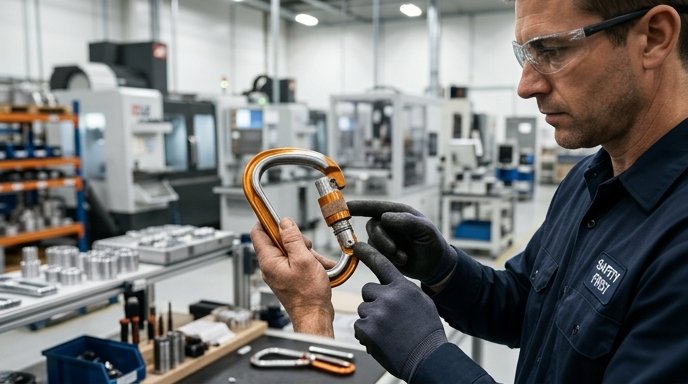
The 60-Second Field Diagnostic
When a locking carabiner gate sticks at the crag or on a job site, you need to decide quickly whether the gear is still safe to use. Industrial rope access techs working under IRATA guidelines run a strict visual and tactile sequence to triage equipment, and it transfers well to recreational climbing.
Start with a visual check of the frame and spine. Look for hairline cracks around the hinge pin and the keylock nose. Next, the gate action test: pull the gate fully open and release it. A healthy spring snaps the gate shut instantly. If the gate hesitates or stops millimeters short of the nose, the internal spring is either contaminated or fatigued.
Then the sleeve rotation test. Spin the locking barrel through its full range of motion. Gritty resistance means chalk or sand in the threads. If the sleeve needs forced pressure to clear the nose, the frame has probably taken some mechanical deformation and you’re done with that piece.
Based on this 60-second check, assign the carabiner to one of three categories:
- Field-fixable: gritty sleeve or slow gate return with no visible damage.
- Workshop-fixable: heavily seized sleeve that needs hot water and lubrication to recover.
- Retire: any visible bending, missing hinge pins, deep gouges, or anything that just feels wrong in the hand.
That last one isn’t very scientific, I know. After enough inspections you start trusting the “feels wrong” category more than you probably should.
Four Failure Modes, and How to Tell Them Apart
The four failure modes of a locking carabiner gate are debris, corrosion, deformation, and lubricant breakdown. Each presents different physical symptoms, and the symptoms dictate what you do next.
Debris jams happen when chalk, sand, or mud gets into the hinge or sleeve threads. You’ll hear a distinct grinding sound when you work the gate. The BMC has pointed out that aluminum oxide dust, created when a rope runs over the carabiner, mixes with chalk to form a hardened abrasive paste. That paste is the real culprit on most sport-climbing racks, not the chalk by itself.
Corrosion mostly shows up on climbers in marine environments. Seawater leaves salt crystals that oxidize the aluminum and chew up the internal steel spring. It feels stiff and binding rather than gritty, and you’ll often see a white powdery residue around the hinge pin.
Mechanical deformation happens when a carabiner is cross-loaded or dropped from height. The main symptom is misalignment. The gate physically strikes the side of the nose instead of slotting cleanly into the keylock groove.
Lubricant breakdown is the subtle one. Factory grease ages or mixes with dirt, and the gate just feels gummy. The spring still works, it just can’t overcome the sticky residue in the barrel. People misdiagnose this as debris and go after it with a toothbrush when all it needs is a wash and re-lube.
Why Screw-Gates and Auto-Lockers Fail Differently
Screw-gate and auto-locking carabiners rely on different mechanical designs, which means they fail under different conditions. A standard screw-gate, like the Petzl Attache, uses a simple threaded barrel. These fail most often from thread binding. Climbers tighten the screw-gate while the carabiner is weighted, the aluminum frame flexes under load, and when the load comes off the frame relaxes and traps the sleeve.
Auto-locking carabiners (twist-lock and triple-action models like the DMM Boa) contain fiddlier internal spring mechanisms. These fail primarily from spring fatigue and barrel binding. The auto-lock needs a torsion spring to rotate the barrel and a linear spring to close the gate, and both can go south independently.
Because auto-lockers have more moving parts and tighter tolerances, they’re highly susceptible to fine dust. A screw-gate will often power through a light layer of dirt. An auto-locker seizes completely if sand gets into the rotational spring housing. Obviously you wouldn’t rack an auto-locker for a sandstone trip and expect it to still be smooth on day three.
The Right Way to Clean a Stuck Gate (And What Wrecks It)
Clean a stuck carabiner gate by flushing with warm fresh water, working the gate through its full travel, drying it fully, and applying a dry PTFE or silicone lubricant.
Start by submerging the carabiner in warm, soapy water. DMM specifies a maximum water temperature of 40°C (104°F), while Petzl recommends staying below 30°C (86°F). Open and close the gate repeatedly underwater to flush out the chalk and aluminum oxide paste. Rinse with clean water and use compressed air to blow out the hinge. If you don’t have compressed air, a few hard shakes and overnight on a dry towel is fine.
Once completely dry, apply a manufacturer-approved lubricant. Black Diamond recommends a wax-based dry lube such as White Lightning, or a silicone-based lubricant. Petzl permits graphite powder or a dry liquid lubricant like WD-40 Specialist Dry Lube with PTFE. One drop at the hinge, one drop at the top of the barrel threads, work the gate maybe twenty times, wipe off the excess. That’s it. If you can see the lube after wiping, you used too much and you’ve just built yourself a dirt magnet.
Never use standard WD-40. The thing is, standard WD-40 is a water displacer and solvent, not a dedicated lubricant. It strips the factory grease from the internal spring and leaves a wet residue that actively attracts dirt and chalk. Avoid household oils like 3-IN-ONE multi-purpose oil too, which will gum up the mechanism in cold weather. I still see experienced climbers reach for the blue can at the trailhead. It makes me want to throw things.
Field Fixes You Can Actually Do at the Crag
If a locking carabiner seizes halfway up a multi-pitch route, your options are limited. The most effective field fix is the water bottle dunk. Submerge the hinge and sleeve in your drinking water and aggressively work the gate back and forth. Warm water from a thermos is noticeably better at dissolving hardened chalk and sweat paste than cold, and that’s the consensus on r/climbing too if you want to go read the threads.
If a screw-gate sleeve is stuck closed, apply gentle rotational pressure with your thumb and forefinger while pushing the gate inward to relieve tension on the nose. Never use pliers or a nut tool to force a stuck sleeve. The aluminum threads are soft and strip immediately under steel.
Apply strict temporary acceptance criteria before climbing on a malfunctioning carabiner. If an auto-locker needs manual assistance to close, it is no longer a locking carabiner. It functions as a snap-gate. Do not use it for belaying, rappelling, or building master points. Rack gear with it until you can clean it properly at home.
Workshop Fixes and When They’re Worth It
Full disassembly of a locking carabiner isn’t possible for the end user. Manufacturers secure the gate to the frame using riveted steel pins, and removing those pins destroys the carabiner.
Because you can’t open the hinge housing, a “workshop fix” is really just a more aggressive cleaning process: an ultrasonic cleaner to vibrate debris out of the micro-crevices, followed by a targeted hit of dry PTFE lube.
Economically, professional repair is rarely rational. Standard locking carabiners retail between $15 and $25. Shipping one back to a manufacturer costs nearly as much as a replacement, which is why Petzl and Black Diamond don’t offer repair services for standard recreational carabiners. If an ultrasonic bath and dry lube can’t restore the gate action, the unit is done.
Retirement Criteria — The Non-Negotiable Red Flags
Retire a locking carabiner immediately if the gate is deformed, the hinge has visible play, the frame is cracked, or the carabiner has caught any factor-1-or-greater fall.
The UIAA 121 standard requires a locking carabiner to hold 20kN along its major axis when closed. If the gate is stuck open, that strength drops to 7kN. A carabiner that can’t close fully is a severe safety hazard, full stop.
Petzl’s official inspection procedure says that metal products have an indefinite lifespan, unlike nylon slings which expire after 10 years. Practical lifespan is dictated by wear, though. Retire the carabiner if the rope-bearing surface shows more than 1mm of wear, or if the gate rivet is loose. And if you find a carabiner at the crag and don’t know its history, throw it away. Micro-fractures from previous high-factor falls are invisible to the naked eye. I know people who clip booty biners to their harness anyway. I’m not one of them.
Preventing the Next Failure
Preventative maintenance extends the life of a $20 locking carabiner indefinitely. Store your carabiners dry, away from direct UV light and corrosive chemicals like battery acid. Never store locking carabiners loose in a climbing pack next to a leaky chalk bag, which is maybe the single most common cause of avoidable gate failure I see.
Build a rinsing habit. Sea cliff day, rinse in fresh water that same evening to halt salt corrosion before it starts. Dusty sport crag, blow out the hinges with compressed air at the end of the season.
Set a lubrication cadence: a drop of dry PTFE lube on the hinge and sleeve threads twice a year, or after any deep wash. Rotate your lockers too. Don’t run the same single carabiner on your belay device every session for three years. Spreading the wear across the rack keeps any one basket from grooving out early.
FAQ
Can I use WD-40 on a stuck carabiner gate?
No. Standard WD-40 is a solvent that strips factory grease and leaves a wet residue that attracts dirt and chalk. WD-40 Specialist Dry Lube with PTFE is fine, because it dries completely and doesn’t attract grit. Different product, same brand, totally different chemistry.
How long does a locking carabiner last?
Metal climbing gear has an indefinite shelf life per Petzl and Black Diamond. Practical lifespan depends on usage: heavy daily use can wear out a carabiner in a year, weekend use can see one last a decade.
Is a sticky carabiner safe to climb on?
No. A locking carabiner with a gate that stays partially open loses more than half its rated strength, dropping from roughly 20kN to 7kN. Treat it as a snap-gate until the mechanism is cleaned and fully functional, or retire it.
What’s the best lubricant for carabiner gates?
Dry, wax-based or PTFE-based fluids. White Lightning bike lube, Metolius Cam Lube, or 3-IN-ONE PTFE dry lube all penetrate the hinge and dry without leaving a sticky residue.
Author holds current SPRAT Level 1 certification and has spent over a decade testing climbing and rigging equipment in alpine and industrial environments.