TL;DR: A “military-grade” carabiner is a locking connector that meets load-bearing standards used by armed forces, typically NFPA 1983 (now NFPA 2500) or EN 362, with a minimum major-axis strength of 27–40 kN. Most issued hardware is hot-forged 7075-T6 aluminum or alloy steel with an auto-locking gate. There is no single unified MIL-SPEC document for carabiners. The military buys certified commercial-off-the-shelf gear and assigns it an NSN.
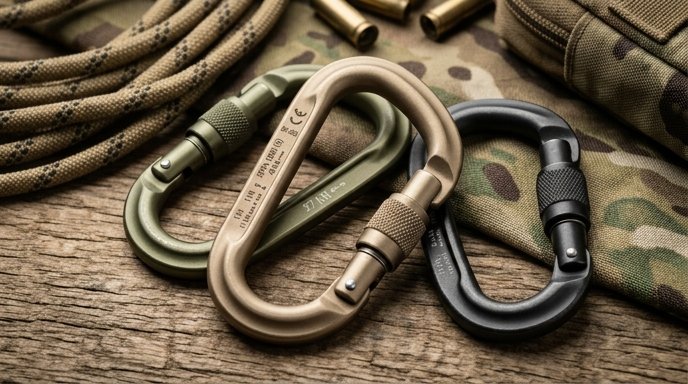
The “Military-Grade” Label — What It Actually Guarantees (and Doesn’t)
“Military-grade,” on a carabiner, is marketing. Search the DLA ASSIST database and you will not find an active, unified MIL-STD or MIL-PRF that dictates dimensions, materials, and load ratings for a universal military carabiner.
What actually happens: the DoD procures Commercial Off-The-Shelf life-safety equipment. When a carabiner gets a National Stock Number, the procurement contract typically requires it to meet civilian life-safety standards — NFPA, CE EN 362, or ANSI Z359.12. The only strictly military regulation that touches these connectors is the Berry Amendment (10 U.S.C. § 2533a), which pushes preference toward domestically sourced and smelted specialty metals.
So when a manufacturer calls a carabiner “military-grade,” what they usually mean (if they mean anything) is that the hardware mimics the specs of COTS gear currently holding active NSNs. If they can’t show you an EN, NFPA, or ANSI certification, the thing is an accessory clip. Not life safety. Doesn’t matter what color the anodizing is.
Reading a Carabiner Spine — The Three Numbers That Matter
Every certified carabiner is engraved with three strength ratings: major axis closed, major axis gate-open, and minor axis. These are the Minimum Breaking Strength (MBS) in kilonewtons at which the carabiner is expected to fail under laboratory conditions. 1 kN is roughly 224.8 lbf.
Major axis closed is the big number, usually 24–40 kN. That’s the carabiner loaded end-to-end, gate fully secured. Minor axis is the carabiner stressed across its width (cross-loaded), and it typically drops the MBS to somewhere between 7 and 11 kN. The gate-open number is the major-axis strength if the gate is snagged or fails to close.
Take the Petzl Am’D, a common tactical carabiner. Its spine reads 27 kN major, 8 kN minor, 7 kN open.
Gate-open failures account for a disproportionate share of rigging accidents, and the math is ugly: that same 27 kN carabiner, gate open, is suddenly a 7 kN (1,573 lbf) connector. A two-person dynamic shock load clears that threshold without trying.
NFPA 1983 “G” vs “T” — The Standard Military and SAR Actually Use
NFPA 1983 classifies carabiners as either General Use (G) or Technical Use (T). In 2022 NFPA 1983 was consolidated into the broader NFPA 2500 standard, but manufacturers and military riggers still talk in G and T. Military and SAR teams default to G-rated hardware for any two-person load or helicopter-insertion rigging.
Technical Use (T): minimum major-axis MBS of 27 kN (6,069 lbf). Single-person loads. Standard for individual operator bailout kits and personal retention lanyards.
General Use (G): minimum major-axis MBS of 40 kN (8,992 lbf). Both classifications require a minimum minor-axis and gate-open strength of 11 kN (2,473 lbf).
| Classification | Major Axis MBS | Minor/Open MBS | Typical Military Application |
|---|---|---|---|
| Technical (T) | 27 kN (6,069 lbf) | 11 kN (2,473 lbf) | Personal retention, single-operator rappel |
| General (G) | 40 kN (8,992 lbf) | 11 kN (2,473 lbf) | SPIE rigging, two-person rescue, litter operations |
The 40 kN requirement for G adds real weight. A standard T-rated aluminum carabiner comes in around 75 grams; a G-rated steel one can push past 250. On a full rack, that adds up.
Materials Under Fire — 7075-T6 Aluminum, Steel, and the Titanium Question
This is the section I actually care about, because material choice drives everything else — weight, fatigue life, how the carabiner behaves after it’s been dropped off a Humvee a few times.
The vast majority of tactical carabiners are hot-forged from 7075-T6 aluminum. The alloy has a yield strength of roughly 73,200 psi (505 MPa). For personal load-bearing gear, nothing else gives you that strength-to-weight ratio at a reasonable cost. 6061 won’t get you there, and nobody’s forging life-safety hardware out of 2024.
Steel carabiners (alloy steel, or 4130 chromoly) are issued for the high-wear jobs. Steel shrugs off the abrasive friction of fast-roping and takes repeated steel-on-steel contact at helicopter hard-points without visibly degrading. The SMC Large Steel Locking carabiner hits an MBS of 45+ kN and weighs roughly 10.6 ounces, versus about 2.6 ounces for an aluminum equivalent. On a rescue rack where every connector is steel, your harness feels it by hour three.
Titanium barely shows up in military carabiners and the reasons are both practical and metallurgical. Yes, titanium is corrosion-resistant, which matters for maritime work, but it’s a bear to hot-forge into the complex geometries that modern auto-locking carabiners require. The dies wear faster, the rejection rate goes up, and nobody wants to pay $140 for a connector that saves them 15 grams. Titanium is also more brittle than 7075-T6 under sudden impact, which is a bad trait for hardware that occasionally gets slammed into rock or plate carriers during a dynamic fall. I still spec titanium shackles for some freshwater and dive work, honestly out of habit more than engineering justification, but for a carabiner on a harness? Aluminum or steel.
Locking Mechanisms, Ranked by Failure Mode
Tactical environments bring mud, ice, and vibration. Each one exposes a different weakness in the locking mechanism.
- Triple-Action Auto-Lock (3-Stage): Lift, twist, pull. The standard for military life-safety work. Very resistant to accidental opening from rope friction or body contact. Fails when mud or ice packs into the locking sleeve and the gate won’t snap shut.
- Twist-Lock (2-Stage): Twist and pull. Faster to operate one-handed with heavy gloves than a triple-action. Will roll open if a rope drags across the sleeve under tension.
- Screw-Gate: A threaded sleeve you spin over the nose by hand. Users on tactical forums report screw-gates vibrating open during helicopter transit or when rubbing against plate carriers. Fine for static tension applications. Not fine on a kit that moves.
- Magnetic Auto-Lock: Mechanisms like the discontinued Black Diamond Magnetron used magnetic arms to lock onto a steel insert in the nose. Clever design. Operators in desert environments reported that iron-rich sand and magnetic debris fouled the mechanism and left gates stuck open.
Shape Dictates Function — Oval, D, Offset-D, and HMS in Tactical Rigging
Shape determines where the load goes. US Army TC 3-97.61 (Military Mountaineering) covers specific uses for different shapes in rigging systems.
- Offset-D: The most common shape for personal tactical use. The asymmetrical design pulls the load onto the solid spine, away from the weaker gate. Best strength-to-weight of the common shapes.
- HMS (Pear-Shaped): HMS stands for Halbmastwurfsicherung, German for the Munter hitch. The wide basket takes the thick knots and multiple rope strands you need for an emergency rappel bail-out when you don’t have a descender.
- Oval: The original carabiner shape. Symmetrical, so it doesn’t shift under load. Required for pulley systems — an offset-D will cant the pulley sideways and the rope ends up grinding on the side plate.
- True D: Largely gone from modern tactical kits. The offset-D is lighter and more ergonomic for roughly the same strength.
Beyond the Spec Sheet — Cyclic Loading, Cross-Loading, and Manufacturing Lineage
The kN rating on the spine is a single-event static pull to destruction. That is not what your gear sees. Real tactical use is cyclic: repeated shock loads, drops onto concrete, cross-loading against other hardware on an overloaded harness.
Cross-loading is the quiet killer. Break testing done by DMM shows that a carabiner rated 27 kN on its major axis will routinely fail somewhere between 7 and 11 kN when loaded across its minor axis. Anecdotally, the real-world failures I’ve seen cluster toward the lower end of that range, especially on older hardware.
Manufacturing lineage matters more than most buyers realize. High-end tactical carabiners are hot-forged — the aluminum is heated and pressed into a die, which aligns the internal grain structure with the shape of the carabiner and lengthens fatigue life considerably. Cheaper carabiners get cold-forged or machined from extruded bar stock, which cuts across the grain and leaves you with a connector that handles its first few loads fine and then quietly loses capacity over years of service you’ll never notice until it matters.
Buying Checklist — Separating Issued-Grade from Airsoft-Grade
Check the hardware itself. The spine will tell you.
- CE Mark with Notified Body Number. A legitimate European PPE certification has “CE” followed by a four-digit number identifying the testing laboratory (CE 0082 is Apave Sudeurope, for example). A bare “CE” with no number is often the “China Export” look-alike.
- Three-axis kN ratings engraved on the spine: major, minor, gate-open. One number only (like “12 kN”) means it’s an accessory clip. Walk away.
- ANSI Z359.12 stamp if you’re buying for industrial or aviation fall protection. Z359.12 requires the gate itself to withstand 3,600 lbf (16 kN) of direct force, which is a stricter requirement than standard EN 362.
- Batch or serial number. Life-safety hardware needs traceability. Laser-engraved serial or batch code, non-negotiable, for recall tracking.
If the carabiner is missing any one of these, it is not life-safety equipment regardless of what the Amazon listing says.
FAQ
Is there an official MIL-SPEC for carabiners?
No. DoD doesn’t maintain a MIL-STD or MIL-PRF for carabiners. NSNs get assigned to commercial carabiners that meet civilian standards (NFPA 2500, EN 362, ANSI Z359.12).
What’s the minimum kN rating for military use?
For personal retention and single-person loads, 27 kN major-axis (Technical Use). For two-person loads, rescue, or helicopter rigging, 40 kN (General Use). These are minimums under NFPA; most issued hardware exceeds them because manufacturers build in margin against die wear, batch variation, and the fact that any serious inspection program will downgrade a carabiner for cosmetic damage long before the metal is actually compromised. In practice, if you’re buying for a team, spec well above the minimum and don’t try to shave grams on connectors.
Can I use a climbing carabiner for tactical applications?
Yes, if it’s a locking carabiner certified to EN 12275 or UIAA 121. Recreational climbing carabiners are often brightly colored and may use lighter, thinner aluminum profiles that wear faster under heavy tactical use.
Why do some carabiners cost $5 and others cost $40?
A $5 carabiner is uncertified. A $40 carabiner is hot-forged 7075-T6, individually proof-loaded at the factory, and third-party certified.
What do the symbols engraved on the spine mean?
MBS in kilonewtons across three axes: solid arrow for major (end-to-end), horizontal arrow for minor (side-to-side), open-gate symbol for major with the gate failed open.
Author Bio
Dave Mercer is a certified rigging specialist and former Army engineer with 14+ years inspecting life-safety equipment for SAR and tactical use. He holds certifications in fall protection and high-angle rescue rigging and spends more time than he’d like reading PPE spec sheets.