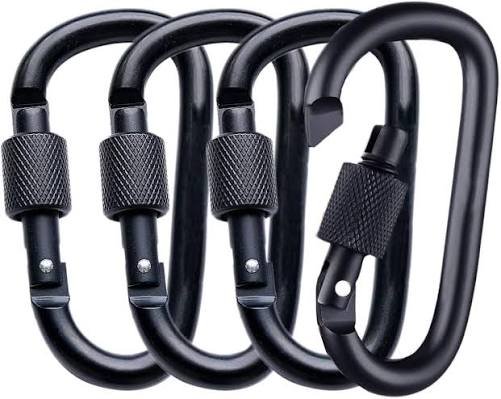
Screw gate carabiners lock manually via a threaded sleeve. Auto-lock carabiners engage the sleeve automatically after gate release. Screw gates win on simplicity and cost. Auto-locks win on human-error resistance. For most recreational climbers, a mixed rack gives you the safest balance: directional auto-locks for belaying, lightweight screw gates for anchor building.
How Each Locking Mechanism Physically Works
A screw gate uses a rotating threaded sleeve. You need three to five manual rotations to secure it. Modern iterations refine this basic action in small ways. Petzl models put a red visual band on the gate, and the red only disappears when the sleeve is fully tightened. Simple, but it works.
An auto-lock carabiner uses an internal spring-loaded sleeve that engages the moment the gate closes. Auto-locks divide into three primary sub-types:
- 2-Action (Twist-lock): Twist the sleeve 90 degrees, then push the gate open.
- 3-Action (Triple-action / Triact-lock): Push the sleeve up (or pull it down), twist 90 degrees, push the gate inward.
- Magnetic / Specialist: Designs like the discontinued Black Diamond Magnetron or the Skylotec Pinchlock II, which use magnetic arms or pinch triggers instead of rotating sleeves.
| Mechanism | Actions to Open | Actions to Lock | One-Handed Operable? | Primary Failure Mode |
|---|---|---|---|---|
| Screw Gate | 1 (Unscrew) | 1 (Screw) | Yes | User forgets to lock it |
| 2-Action Auto | 2 (Twist, push) | 0 (Automatic) | Yes | Snagging on external gear |
| 3-Action Auto | 3 (Slide, twist, push) | 0 (Automatic) | Hard | Jamming from grit or ice |
The Safety Data Nobody Cites Correctly
Most climbing instruction defaults to calling auto-lockers “safer.” The thing is, incident data tells a more technical story. The failure modes differ, but mechanical failures are exceedingly rare compared to human error.
According to the American Alpine Club’s Accidents in North American Climbing reporting, belay-side incidents frequently involve incomplete locking or cross-loading. I don’t have a clean percentage breakdown, since the AAC groups incidents by “belay error” or “anchor failure” rather than isolating the locking mechanism itself. Anecdotally, though, the unlocked-carabiner category shows up often enough that anyone who’s read a few volumes will recognize the pattern. Neither system guarantees immunity from user error.
Under CE EN 12275 and UIAA 121, a standard Type H (HMS) carabiner must withstand 20 kN on its major axis. Cross-load it on the minor axis and that minimum drops to 7 kN. Open the gate and it falls to 6 or 7 kN. Those are floor ratings, not typical performance, but the floor is what you should design your systems around.
Screw gates are vulnerable to gate flutter. Testing by DAV Sicherheitsforschung has shown that vibrations from a running rope can back a loosely tightened screw sleeve off completely. Auto-locks resist flutter but introduce a different risk. The sleeve can snag on a nylon sling or belay loop during closing. The internal spring snaps back, you hear a click, you assume the system is closed. The gate is actually resting slightly open. This second failure mode is the one that scares me more, because there’s no visual tell.
Where Screw Gates Still Win
Auto-locks are not a blanket upgrade. Screw gates dominate specific climbing disciplines for mechanical reasons, and if you’re getting all your gear advice from gym belayers you may not have heard about half of these.
Anchor building. A multi-pitch anchor typically eats three to four locking carabiners. Screw gates cost less and hold effectively for static, non-moving loads where vibration is absent. Bulk pricing on screw gates versus auto-locks is not a subtle difference.
Cold and icy environments. Auto-lock mechanisms freeze. Ice climbers regularly report 3-action carabiners locking shut when internal springs ice over, which turns a $30 carabiner into a paperweight. Screw gates let you manually force the ice apart by twisting the threads. Not elegant, but it works when you’re 200 feet up and cold.
Sandy and muddy conditions. Canyoneering destroys spring-loaded sleeves. A grit-filled auto-lock becomes a non-locking carabiner the moment the spring fails to return the sleeve. A screw gate’s wide threads can be forced closed even when heavily contaminated.
Visual partner checks. A belayer can spot the red warning band on an unlocked Petzl screw-lock from ten feet away. An auto-lock requires physical squeezing to verify it didn’t snag open on a belay loop.
Real-World Scenario: An ice climber high on a route drops a tool and needs to clip into an ice screw immediately. Their twist-lock belay carabiner has frozen solid from dripping meltwater. They spend 30 seconds beating the aluminum against the ice to free the mechanism.
Real-World Scenario: A climber in a sandstone environment pulls a rope through a sandy anchor. Fine grit blows into their 3-action carabiner. By the third pitch, the sleeve no longer springs back, and the gate is entirely unlocked.
Where Auto-Locks Are Non-Negotiable
Specific disciplines and industrial sectors mandate auto-locking mechanisms because the tasks are high-repetition or the consequences of human error are severe.
Via Ferrata: CE EN 12275 Type K (Klettersteig) carabiners legally require an automatic locking device.
Tree Care and Rope Access: Industrial standards leave zero room for preference. ANSI Z133 for arboriculture mandates self-double-locking (3-action) carabiners for life-safety connections. SPRAT and IRATA permit screw gates for some isolated applications but heavily favor auto-locks for primary fall-arrest systems.
Guided Top-Rope Instruction: The AMGA Single Pitch Instructor curriculum requires candidates to carry at least six locking carabiners. Guiding services standardize on auto-locks for client tie-ins to eliminate the chance of a distracted beginner unscrewing their own connection. I’ll admit, when I was still guiding I ran auto-locks on my clients even in situations where a screw gate would have been fine. Old habit, not fully justified.
The Discipline-by-Discipline Buying Guide
| Discipline | Recommended Lock Type | Why | Example Model to Research |
|---|---|---|---|
| Sport Climbing Belay | 2-Action Auto or Gridlock | Frequent opening/closing; prevents minor-axis cross-loading | Black Diamond GridLock Twistlock |
| Trad Anchor | Screw Gate | Lighter weight, cheaper in bulk, unaffected by dirt | Petzl Sm’D Screw-Lock |
| Ice / Mixed Climbing | Screw Gate or Twin Gate | Resists freezing; usable with heavy gloves | Grivel Clepsydra Twin Gate |
| Via Ferrata | Auto-Lock (Mandated) | CE EN 12275 Type K requirement | Mammut Skywalker Classic |
| Gym / Top-Rope | 3-Action Auto | Eliminates beginner distraction errors | Petzl Am’D Triact-Lock |
| Rope Access / Arborist | 3-Action Auto | ANSI Z133 compliance | DMM Durolock |
Cost, Weight, and Longevity Reality Check
Compare identical frames and the actual penalty of choosing an auto-lock becomes clear.
Price. As of mid-2026, a Black Diamond RockLock Screwgate carries an MSRP around $14.95. The exact same frame in the RockLock Twistlock version runs $29.95. Outfit a full trad rack with auto-locks and you’ve doubled the carabiner budget for what’s often a marginal safety gain in that specific use case.
Weight. The weight penalty is basically nothing. A Petzl OK Screw-Lock weighs 70 grams. The OK Triact-Lock weighs 75 grams. Five grams. If you’re counting grams that carefully, you’re not the target audience for this article.
Longevity. Auto-locks retire earlier. The internal spring goes through thousands of compression cycles, and when it weakens the carabiner either fails closed or fails open, neither of which you want. Screw gates rely on aluminum threads that often outlast the wear limit on the rope basket itself. Manufacturers spec a maximum 10-year lifespan for aluminum hardware, but mechanical wear usually forces retirement before you hit the decade mark anyway.
Maintenance, Inspection, and When to Retire
Improper cleaning damages the aluminum and the internal springs. Some of this is obvious, some isn’t.
How to test a screw gate. Thread the sleeve closed and apply heavy thumb pressure sideways against the gate. If the sleeve slips or the threads jump, retire the unit.
How to test an auto-lock. Open the gate fully, release it slowly. The spring must return the sleeve to fully locked without manual help. If the sleeve stops halfway, the mechanism needs cleaning.
Cleaning protocol. Petzl directs users to wash carabiners in lukewarm water with standard household face or body soap. Do not use high-pressure sprayers. Rinse with fresh water. If action remains sluggish after drying, apply a light non-sticky lubricant directly to the hinge and wipe away excess to prevent grit accumulation.
Visible retirement triggers:
- Hairline cracks near the gate rivets.
- Grooves deeper than 1 millimeter worn into the rope basket.
- Sticky sleeves that don’t resolve after washing and lubrication.
Carabiner inspection checklist:
- Check the rivets for flush seating.
- Inspect the nose slot on keylock models for burrs.
- Test the spring tension against slow closing.
- Measure basket wear against the 1mm threshold.
How to Choose in Under 60 Seconds
Quick decision tree if you’re standing in the shop:
- Ice climbing, canyoneering, or building trad anchors? Screw gates.
- Belaying in a gym or guiding a beginner? 3-action auto-lock.
- Managing an assisted-braking device on sport routes? 2-action twist-lock or a directional belay carabiner.
Suggested starter setups:
- Your first two lockers: One HMS screw gate for master points, one directional twist-lock for your belay device.
- Rounding out a rack: Four to six lightweight D-shaped screw gates for anchor building.
- Guide-level kit: Triple-action auto-locks for all client attachment points, screw gates for the master point.
For most recreational climbers, a mixed rack gives you the most utility. No single locking mechanism perfectly handles every climbing scenario.
FAQ
Can a screw gate carabiner unscrew itself during use?
Yes. It happens through a phenomenon called gate flutter. Vibration from a running rope can slowly back the sleeve off, especially if it’s under-tightened or rubbing directly against rock. I’ve had it happen once on a long pitch where the rope was singing against the sleeve for maybe fifteen minutes, and when I finally looked down the sleeve was three full turns loose. That was the moment I started buying auto-locks for anything with active rope motion. The physics are boring but they’re real, and if you climb long enough you’ll see it eventually.
Do climbing gyms require auto-locking carabiners?
Many modern commercial gyms strongly recommend them for belaying, and some mandate them for top-rope floor attachments. Policies vary. Check with your specific facility.
What’s the difference between twist-lock, ball-lock, and triple-action?
Twist-lock requires two movements (twist and push). Triple-action requires three (slide up or down, twist, push). Ball-lock is a Petzl-specific triple-action design where you press a small green ball to release the twist mechanism.
Should beginners start with screw gates or auto-locks?
Screw gates. Build the muscle memory of actively locking your gear and checking your partner’s. Auto-locks can create complacency, and complacency is worse than a slow lock.