Yes, you can wash a carabiner with warm water and mild soap. Never use solvents, bleach, or a dishwasher, and always inspect and relubricate the gate before putting it back on your harness. If the gate still sticks after a proper clean, retire it.
The Short Answer (and the One That Actually Matters)
You can and should wash your carabiners. Cleaning doesn’t weaken the 7075-T6 aluminum, and mild soap won’t eat the anodized finish. The point of washing isn’t sterility. It’s restoring the mechanical function of the gate spring and clearing abrasive grit out of the locking sleeve threads.
Petzl, Black Diamond, and DMM all explicitly recommend washing sticky gear. A carabiner that doesn’t snap shut automatically is a critical safety hazard, full stop. Washing removes the physical crud preventing that closure.
Quick Reference: Carabiner Cleaning
- Do: Wash in warm water, max 30°C / 86°F.
- Do: Use mild dish soap (pH 6 to 8).
- Do: Lubricate the gate hinge after drying.
- Don’t: Use bleach or acid.
- Don’t: Run them through the dishwasher. Ever.
- Don’t: Use standard WD-40.
What’s Actually on Your Carabiner (and What Each Contaminant Does)
Different environments deposit different gunk. What’s gumming up the gate dictates how aggressively you need to clean it.
- Chalk and sweat: Magnesium carbonate plus human sweat forms a dense, cement-like paste that packs into the gate hinge and the sleeve threads. This is what causes most of the sluggish-gate complaints you hear in gyms.
- Sand and grit: Silica is harder than aluminum. When it gets trapped in the hinge, sand becomes a grinding compound working against the stainless gate pin, which chews up mechanical life fast.
- Sunscreen and DEET: DEET (N,N-Diethyl-meta-toluamide) is a solvent that melts nylon and Dyneema slings. It doesn’t structurally weaken anodized aluminum, but it does leave a sticky film that attracts dirt like a magnet.
- Saltwater: Sodium chloride accelerates oxidation. On aluminum, you’ll see pitting and white powdery buildup, and the internal steel spring takes the worst of it.
- Blood and organic matter: A biohazard issue mostly for rescue and SAR folks. Enzymatic cleaners work, but check aluminum compatibility first.
| Contaminant | Risk Level | Urgency |
|---|---|---|
| Chalk / Sweat | Low (Mechanical) | Wash when gate sticks |
| Sand / Silica | Medium (Abrasive wear) | Wash after trip |
| Saltwater | High (Corrosion) | Rinse immediately |
The Correct Washing Procedure, Step by Step
Follow this and you’ll clear the debris without damaging anything.
- Prepare the water. Fill a basin with lukewarm water. Petzl and DMM both specify a max of 30°C (86°F). Hot water gives you zero mechanical advantage and can compromise the rubber seals on some specialized lockers.
- Add mild soap. Standard non-citrus dish soap. pH roughly neutral, 6 to 8. Skip the heavy-duty degreasers.
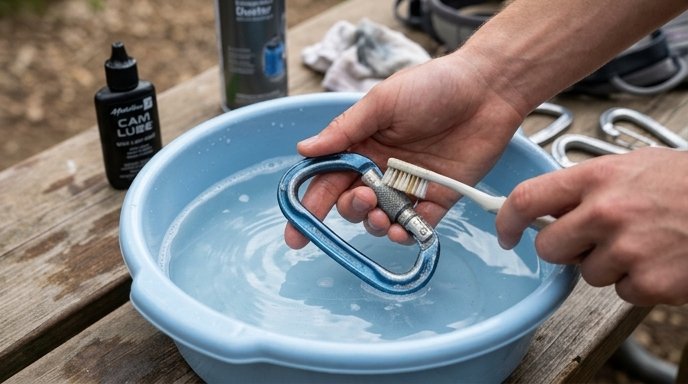
- Scrub the hinge. Submerge the carabiner. Soft-bristle toothbrush on the gate hinge, the sleeve threads, and the nose hook.
- Agitate underwater. With the carabiner still submerged, open and close the gate 15 to 20 times. This flushing action forces water into the internal spring housing to push out trapped chalk paste.
- Rinse thoroughly. Transfer to a basin of clean cold water. Work the gate another 10 times to flush out the soap. Soap residue left behind becomes its own dirt magnet.
- Dry completely. Shake off the excess. Black Diamond recommends blowing out the hinge with compressed air if you have a compressor or a can of duster handy. Otherwise, air dry in a warm, ventilated room away from direct UV or a radiator. Don’t towel dry the hinge, because you’ll just drive lint into the mechanism.
The WD-40 Question — and What to Actually Lubricate With
Washing strips the existing lubricants. You have to relubricate, or the gate will stick worse than before. Which brings us to the single most litigated topic in climbing maintenance: WD-40.
Standard WD-40 is a water displacer and a solvent. It is not a long-term lubricant. It leaves a wet, mineral-oil residue, and the r/climbing crowd will tell you (correctly) that it attracts sand and chalk and gums up the gate within a few weeks of regular gym use. I keep seeing people argue this point and I don’t know why. It’s not controversial. The can literally says “water displacer.”
Use a dry lubricant. Any of these:
- Teflon (PTFE) or wax. Black Diamond specifically names White Lightning, which is a bike chain lube. Works great.
- Silicone. Petzl’s recommendation. Silicone-based oils.
- Climbing-specific. Metolius Cam Lube is a wax-based formula with a solvent carrier that flashes off, leaving a dry, dirt-repellent film. Designed for cams but works fine on biners.
- WD-40 Specialist Dry Lube with PTFE. If you’re married to the brand, this is the one. Not the blue can.
One drop on the gate hinge. Open and close the gate about 10 times to work it into the spring. Then wipe away all the excess with a clean rag, because any lube left on the surface will transfer straight to your rope and your nylon slings, and that’s a bigger problem than a sticky gate.
Honestly, I still catch myself reaching for the blue can out of habit when I’m in a hurry. Old reflex. I know better. Do as I say.
Saltwater, Sand, and Other Field Scenarios That Need Different Rules
Generic instructions fall apart in extreme environments.
Coastal climbing and deep-water soloing. The UIAA Safety Commission has warned for years that 7075-T6 aluminum is highly susceptible to stress corrosion cracking (SCC) in marine environments. Saltwater attacks the metal at a microscopic level. If a carabiner takes a dunk in the ocean, you rinse it in freshwater within hours, not at the end of the trip.
Desert climbing. Fine silica dust, the kind you get in Indian Creek or Zion, turns into concrete-like sludge the moment you drop it into water. Dry-brush the carabiner first. Blow out the hinge with compressed air before any water touches it.
Mixed hardware and galvanic corrosion. If you’re leaving gear fixed on a project, mixing metals causes problems. A steel maillon connected to an aluminum carabiner in a wet environment creates a galvanic cell: the aluminum becomes the anode and corrodes rapidly. Wash and inspect any aluminum gear right after it’s been in prolonged contact with wet steel. Obviously you shouldn’t be leaving aluminum lockers on a sea cliff anchor to begin with, but people do.
What You Must NOT Do
Some cleaning methods will permanently destroy life-safety gear.
- No dishwashers. Dishwasher detergents are highly alkaline, often pH 10 or higher. That caustic environment strips the anodized layer off aluminum in a single cycle, leaving the base metal exposed to rapid corrosion.
- No bleach or ammonia. Chlorine bleach aggressively attacks aluminum alloys.
- No solvents. Acetone, paint thinner, gasoline. All of them degrade rubber seals on specialized lockers and will trash any textile slings they touch.
- No wire brushes. Steel wool or brass brushes scratch the anodization and create micro-abrasions that act as stress risers.
- No boiling. Boiling to “sterilize” them is unnecessary and risks altering the temper of the internal steel spring.
Post-Wash Inspection — The Step Most Guides Skip
Washing removes the grime that was hiding structural damage. Once the biner is clean and dry, run through Petzl’s PPE inspection checklist.
- Snap test. Pull the gate fully open, release it. It must snap shut and lock (if applicable) instantly. Any hesitation means the spring is compromised.
- Wear grooves. Check the rope basket. Retire if the rope has worn a groove deeper than 1mm into the aluminum.
- Visual pitting. Look for white powdery spots or black pitting. Active corrosion.
- Pin and rivet check. The rivet connecting the gate to the basket should be flush, not migrating outward.
- Sleeve rotation. On lockers, spin the sleeve. Should travel the full length of the threads without catching anywhere.
When Washing Won’t Save It — Retirement Criteria
Cleaning cannot fix mechanical failure. Petzl and Black Diamond both state that metal climbing products have an indefinite lifespan, which means they don’t expire after 10 years the way nylon harnesses and ropes do. But they get retired immediately if they meet specific failure criteria.
Retire the carabiner if:
- It was dropped from a significant height onto a hard surface. Micro-fractures aren’t visible to the naked eye.
- The gate still sticks or won’t close completely after a full wash-and-lube cycle.
- The rope-bearing surface has sharp edges or burrs that can’t be smoothed with 220-grit sandpaper.
- The locking sleeve is permanently deformed and won’t engage.
- It held a severe shock load, meaning a massive lead fall with a high fall factor.
One honest admission: I still retire biners that get dropped off anything taller than a route-setter’s ladder, even though the engineering says a drop onto a crash pad or dirt is almost certainly fine. It’s a habit from guiding, not a defensible rule.
FAQ
Does WD-40 damage carabiners?
Standard WD-40 doesn’t chemically damage aluminum, but it leaves a wet residue that attracts sand and chalk and will quickly gum up the gate. Use a dry PTFE or silicone lubricant instead.
Can you put carabiners in the dishwasher?
No. Dishwasher detergents are highly caustic and will strip the anodized finish, leading to rapid corrosion.
How do you fix a sticky carabiner gate?
Wash in warm water with mild dish soap, scrub the hinge with a soft toothbrush, air dry it completely, then apply one drop of dry Teflon or silicone lubricant to the hinge. Work the gate 10 times to distribute it, then wipe the outside clean so nothing transfers to your rope or slings. If the gate still won’t snap shut after all that, the spring is done and the biner is done with it.
How often should I clean my climbing carabiners?
Whenever the gate feels gritty, sluggish, or fails to snap shut instantly. Gym climbers, maybe once a year. Coastal or desert climbers, every few months.
Is it safe to use a carabiner after it’s been in saltwater?
Only if you rinsed it in freshwater immediately. Prolonged saltwater exposure causes stress corrosion cracking in 7075 aluminum.