TL;DR
kN stands for kilonewton, a unit of force equal to about 224 pounds (101.97 kg) at Earth’s gravity. On a carabiner, the kN numbers show minimum breaking strength in three loading conditions: major axis closed (usually 20-30 kN), minor axis (7-10 kN), and gate open (7-10 kN).
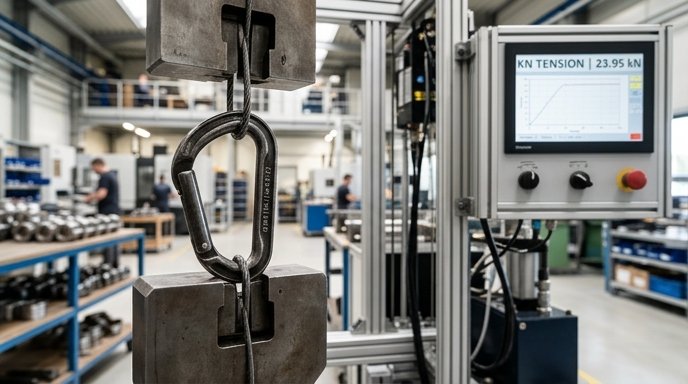
The Kilonewton, Decoded (Without the Physics Lecture)
A kilonewton is a unit of force. One kN equals 224.809 pounds-force (101.97 kgf) under standard Earth gravity. Manufacturers stamp this number on climbing and rigging hardware to indicate Minimum Breaking Strength, or MBS.
The common error, and I see it from new climbers constantly, is treating a kilonewton as a static weight limit. It isn’t. Force accounts for both mass and acceleration. A 200-pound person hanging motionless on a rope applies about 0.89 kN. That same 200-pound person falling six feet before the rope catches generates vastly more force than that. The kN rating tells you the threshold where the aluminum or steel frame deforms and snaps.
Here’s the static conversion table. These are breaking points, not safe working loads. Do not design around them.
| kN Rating | Pounds-Force (lbf) | Kilograms-Force (kgf) | Common Application |
|---|---|---|---|
| 7 kN | 1,573 lbs | 713 kg | Typical gate-open breaking strength |
| 10 kN | 2,248 lbs | 1,019 kg | Heavy-duty minor axis strength |
| 15 kN | 3,372 lbs | 1,529 kg | Lightweight hammock carabiners |
| 20 kN | 4,496 lbs | 2,039 kg | Minimum standard for climbing (Type B) |
| 24 kN | 5,395 lbs | 2,447 kg | Standard HMS/belay carabiner |
| 30 kN | 6,744 lbs | 3,059 kg | Steel industrial rigging carabiner |
Why Your Carabiner Has Three Different kN Numbers
A carabiner shows three ratings because it has three different strengths depending on how force is applied: along the long axis gate-closed, across the short axis, and with the gate open.
The first number, usually printed next to a double-ended arrow pointing end-to-end, is the major axis rating. The carabiner in its strongest orientation, gate closed and locked. EN 12275 dictates that a standard Type B (Basic) climbing carabiner must hold at least 20 kN this way. The Black Diamond RockLock comes in at 24 kN, and the Petzl Sm’D at 23 kN, to give you two common examples.
The second number, marked with a sideways arrow, is the minor axis rating: breaking strength if the carabiner rotates and takes a load across the spine and gate. Because the gate is the weakest link in the loop, strength drops hard. Most climbing carabiners sit between 7 kN and 9 kN on the minor axis.
The third number, marked with an icon of an open gate, is the gate-open rating. If the gate snags on a bolt hanger, or flutters open mid-fall, the carabiner stops being a closed loop and relies on the spine’s resistance to bending. EN 12275 requires at least 7 kN here.
Static Weight vs. Dynamic Force — The Number That Actually Matters
A falling climber puts far more force on a carabiner than their body weight. A short dynamic fall can generate 4 to 8 kN of peak force on the top piece of protection.
When a climber falls, gravity accelerates their mass, and the rope stretches to absorb the energy. Fall severity is measured by the “fall factor” — fall distance divided by rope in the system. A Factor 1 fall (10 feet of fall on 10 feet of rope) generates serious impact forces. The UIAA 101 standard caps the maximum impact force a single dynamic rope can transmit to an 80 kg mass at 12 kN during a severe test fall.
The top carabiner in the system acts as a pulley, though. Force on it equals the force on the falling climber plus the counter-force of the belayer holding the catch. Rope friction over the metal multiplies the force on the top carabiner by roughly 1.66.
The math in action:
An 80 kg climber takes a hard lead fall generating 5 kN on their body. The top carabiner sees roughly 8.3 kN (5 kN × 1.66).
A 24 kN carabiner handles this without flinching. The same carabiner cross-loaded on its 8 kN minor axis gets destroyed by that same 8.3 kN fall.
MBS vs. WLL — Why kN Isn’t the Number You Should Design Around
MBS is Minimum Breaking Strength, the kN rating stamped on the gear. WLL is Working Load Limit, the maximum force the gear should actually see in daily use. Two very different numbers.
Recreational climbing operates almost entirely on MBS. Climbers accept that gear is tested to failure limits and trust the dynamic stretch of the rope to keep real forces well below those limits. There is no formal WLL in rec climbing.
Industrial and rescue work does it differently. A safety factor is the ratio between MBS and WLL. 40 kN MBS carabiner, 10:1 safety factor, you get a 4 kN WLL. That’s the number you design around.
| Industry / Application | Typical Safety Factor | Example WLL for a 24 kN Carabiner | Standard |
|---|---|---|---|
| Recreational Climbing | N/A (Relies on MBS) | N/A | EN 12275 / UIAA 121 |
| Arboriculture (Life Support) | 10:1 | 2.4 kN (539 lbs) | ANSI Z133 |
| Aerial Arts / Silks | 10:1 (Dynamic loads) | 2.4 kN (539 lbs) | Aerial Essentials Rigging |
| Industrial Fall Protection | 5,000 lb anchor minimum | Requires specific steel hardware | OSHA 1910.140 / ANSI Z359 |
This is where I get grumpy. Using a 24 kN aluminum climbing carabiner to hang a 1,000 lb (4.4 kN) static load for a theater rig violates the 10:1 standard, even though the load is nominally below the breaking strength. I watched a load-in once where someone had rigged a mid-weight set piece from a quickdraw’s biner because “it’s rated to 22 kN, we’re nowhere near that.” We’re not nowhere near that. We’re 2.2 kN away from the WLL on a piece of gear that wasn’t designed for continuous static load, and we have no idea what the shock load looks like if the piece swings. We re-rigged it with a steel shackle before the next cue. This is the thing that gets me about MBS-vs-WLL confusion: it looks fine, right up until it isn’t, and then the margin you thought you had turns out to be the margin you were already using. Theater and arborist rigging aren’t climbing. Different gear, different math, different standards. Buy the shackle.
How Carabiners Actually Fail (Loading Mistakes That Cut Strength in Half)
Carabiners rarely break when loaded correctly on their major axis. Failures almost always come from improper loading that forces the carabiner onto its minor axis or an open gate.
- Cross-Loading. The carabiner rotates so the load pulls against the spine and gate. Instantly reduces a 24 kN carabiner to its 7-9 kN minor axis rating. Belay loops cause this constantly if the belayer isn’t using a captive-eye or anti-cross-loading biner.
- Nose-Hooking. The worst one. The carabiner snags on a bolt hanger by its nose, gate open, load resting on the tip of the basket. Black Diamond QC Lab testing shows nose-hooked carabiners failing around 1.7 to 2 kN. Under 450 lbs. That will break under body weight.
- Levering over an edge. Carabiner rests horizontally over a rock edge, takes a load, and now the metal frame is dealing with bending forces it was never designed to see.
- Gate Flutter. During a dynamic fall, the rope vibrating through the carabiner can cause the gate to rapidly open and close under its own mass. If peak force hits in the exact millisecond the gate is open, the carabiner fails at its 7 kN gate-open rating. Wiregates have less gate mass than solid gates, which is why they’re the standard answer for anything likely to see whipper vibration.
Matching kN Rating to Your Actual Use Case
Different activities need specific carabiner shapes and minimum strengths. Buying the highest kN rating available usually just means lugging around heavy steel hardware that adds zero safety for recreational use.
Sport and Trad Climbing.
Look for CE/UIAA certification. EN 12275 Type B must hit 20 kN major, 7 kN minor, 7 kN open. A 20 kN rating already provides a massive safety margin for lead falls. Lightweight wiregates like the DMM Phantom hit around 23 kN at roughly 28 grams.
Belaying and Rappelling.
Type H (HMS) pear-shaped carabiner. Standard requires 22 kN major, 7 kN minor, 6 kN open. The wide basket accommodates a Munter hitch or a modern belay device.
Industrial Fall Protection.
Climbing carabiners are not OSHA-compliant for fall protection. ANSI Z359.12 requires industrial connectors to have a gate face and side load strength of 3,600 lbs (16 kN). A standard climbing carabiner gate fails at around 1,500 lbs (7 kN) if pressed against a steel beam.
Hammock Camping and Slacklining.
Hammock suspensions generate surprisingly high forces because of vector math. A 200 lb person in a hammock strung tight at roughly a 5-degree angle generates somewhere in the ballpark of 1,100 lbs (4.9 kN) of force on each anchor — the exact number depends on sag percentage, but it’s a lot more than people expect. Standard 12 kN accessory carabiners are not enough. Use full-strength 20+ kN climbing carabiners. Slacklines generate even higher continuous tension and need steel shackles, not aluminum biners.
When to Retire a Carabiner (Rating Doesn’t Matter If It’s Compromised)
A 24 kN rating only applies to a carabiner in good condition. Petzl says metal products have an indefinite theoretical lifespan, but real-world wear is what decides retirement.
Visual wear grooves. Rope friction slowly saws through aluminum. If the rope groove on the basket is deeper than about 1mm, retire it. Sharp edges on a worn groove can slice a loaded rope at forces well below the carabiner’s breaking strength, which is a failure mode nobody wants to find out about live.
Gate function. If the gate doesn’t snap shut and lock on its own, clean it. If cleaning and a dry Teflon spray don’t fix the sluggishness, the spring is done. Retire it.
Drop damage. Climbers on r/climbing argue about this constantly: does dropping a carabiner on concrete create invisible “microfractures”? Black Diamond and Petzl have drop-tested aluminum biners from 30+ feet onto concrete and then pull-tested them. No measurable loss in kN strength. Microfractures in modern forged aluminum climbing gear are a myth. If a drop causes visible deformation, sharp burrs, or gate misalignment, that’s a different story — retire it. But a biner that falls off your harness in the parking lot is still a biner.
I’ll admit I still retire personal gear more aggressively than the data supports. Old habit from the theater days, where you retire anything that even looks tired because the liability math is different. Not justified for recreational climbing. I do it anyway.
FAQ
How many pounds is 24 kN?
24 kilonewtons equals about 5,395 pounds-force. Standard major-axis breaking strength for most full-sized locking carabiners.
Is a 20 kN carabiner strong enough for rock climbing?
Yes. 20 kN (4,496 lbs) is the minimum major-axis strength required by EN 12275 for Type B climbing carabiners, and the maximum impact force generated by a severe lead fall on a dynamic rope is capped at 12 kN. You’ve got a comfortable margin as long as the biner is loaded correctly — which, honestly, is the whole catch.
Why is the gate open rating so much lower?
Gate closed, the carabiner is a continuous loop and force distributes across the spine and the gate side. Gate open, it’s a hook. All the force goes into bending the spine, and it snaps around 7 to 9 kN.
Can a carabiner break during a normal fall?
Loaded on the major axis with the gate closed, no. In the real world, carabiners break when they’re cross-loaded, nose-hooked, or levered over an edge.
What kN carabiner do I need for a hammock or aerial yoga?
For hammocks, minimum 20 kN climbing carabiner. Tight hammock angles multiply force, and you can hit 4 to 5 kN of tension easily. For aerial yoga, the industry standard is a 10:1 safety factor on dynamic loads, which is why aerial riggers use steel carabiners rated to 40 kN or higher. Aluminum climbing biners don’t belong in a silks rig.