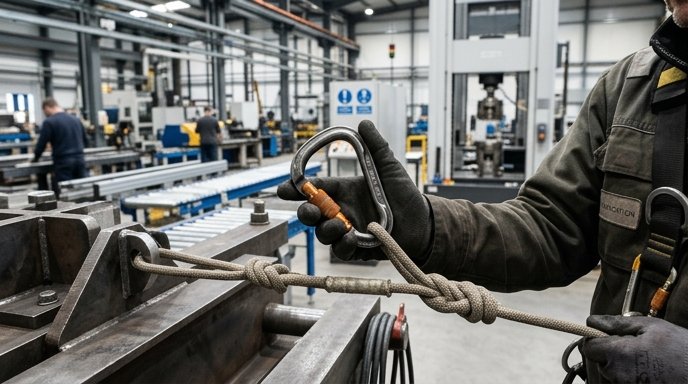
What Is an HMS Carabiner Used For?
TL;DR: An HMS carabiner is a pear-shaped locker built for belaying, rappelling, and anchoring. The wide basket gives a Munter hitch room to flip without jamming. Most HMS models rate 22–25 kN on the major axis, but the same wide geometry that makes them useful also makes them easier to cross-load, and their minor-axis numbers tend to be lower than a D-shape’s. The Shape That Defines the HMS The pear shape has one job: give a Munter hitch enough room to flip without binding. An HMS is noticeably asymmetrical compared to a standard D. The top end, the basket, flares out, and that wide radius lets two strands of a 8.5–10.5mm rope sit side by side without pinching. The European standard EN 12275 classifies these as “Type H” connectors. To earn the stamp, the carabiner has to meet minimum strengths of 20 kN on the major axis, 7 kN on the minor axis, and 5 kN with the gate open. Five parts worth knowing if you’re going to talk about these things sensibly: Basket: the wide, curved top where the rope or belay device sits Spine: the solid, non-opening side Gate: the hinged bit Stock: the metal body itself, usually
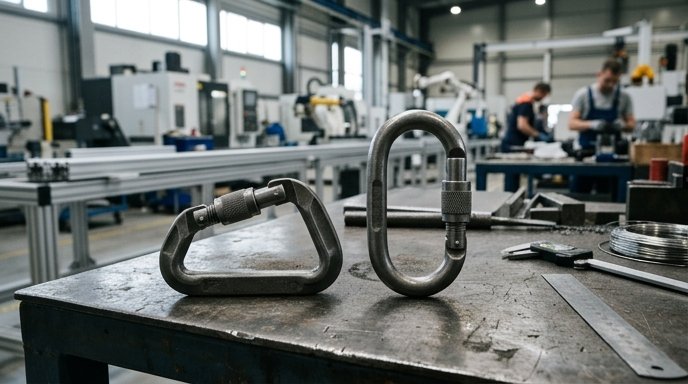
D-Shape vs Oval Carabiner: Strength Comparison
D-shape carabiners are stronger than ovals of equivalent material and size, typically rated 24–27 kN versus 23–25 kN on the major axis, because the asymmetric geometry forces load onto the solid spine. Ovals still win in symmetric-loading applications like pulleys and aid ladders, where gear alignment matters more than peak strength. The Geometry That Decides Everything Carabiner shape determines strength because it dictates how force travels through the metal frame. An oval distributes a load roughly equally across its two sides. When weighted, the solid spine takes about half the force and the gate side takes the rest. The gate, relying on a small steel pin and a spring, is the weakest point of any carabiner. Always has been. A D-shape alters this geometry to protect the gate. The asymmetric design shifts the load path away from the opening, so when a rope pulls tight it slides into the narrowest point of the “D,” which sits directly in line with the spine. The solid aluminum or steel spine ends up carrying the vast majority of the load. By keeping force off the gate, a D-shape achieves higher major-axis ratings using the same amount of metal. What the kN Numbers Actually

When to Use a Bent Gate Carabiner?
TL;DR: Bent gate goes on the rope end of a quickdraw, where the curve helps you clip faster on sport routes. Keep it off bolt hangers and anywhere you’d otherwise want a locker. A bent gate on a bolt hanger can hook the hanger during a fall and unclip itself from the wall. That’s not theoretical. The Shape That Changes Everything (and Why It Only Works One Direction) The curve on the gate does one job: it funnels the rope. Push a rope against a straight gate and it can slide along the gate’s length before anything useful happens. A bent gate makes a cradle. The rope drops into the apex, concentrates the inward push, and pops the gate open with less effort from your fingers. That geometry only works one way. The same curve that invites a rope in will happily let something else out if you load it wrong. The whole design assumes the rope is sitting cleanly in the bottom basket. Three features define a modern bent gate: The curve — anywhere from subtle (BD HotForge) to aggressive (DMM Alpha Sport). The nose — usually Keylock, so the rope doesn’t catch when you’re cleaning. Gate tension —

Why Your Locking Carabiner Gate Won’t Close
A locking carabiner gate fails to close for four main reasons: debris in the hinge, corrosion of the spring, a bent gate from a fall or load, or sleeve seizure from chalk and dirt. Diagnose by testing the gate action, clean with warm water and PTFE lubricant, and retire the carabiner immediately if the frame is deformed. The 60-Second Field Diagnostic When a locking carabiner gate sticks at the crag or on a job site, you need to decide quickly whether the gear is still safe to use. Industrial rope access techs working under IRATA guidelines run a strict visual and tactile sequence to triage equipment, and it transfers well to recreational climbing. Start with a visual check of the frame and spine. Look for hairline cracks around the hinge pin and the keylock nose. Next, the gate action test: pull the gate fully open and release it. A healthy spring snaps the gate shut instantly. If the gate hesitates or stops millimeters short of the nose, the internal spring is either contaminated or fatigued. Then the sleeve rotation test. Spin the locking barrel through its full range of motion. Gritty resistance means chalk or sand in the threads. If

How to Use a Triple Action Locking Carabiner?
TL;DR: A triple action locking carabiner needs three distinct motions, usually lift-twist-open, to release the gate. That extra step keeps the gate from rolling open against a rope or an edge. To use one: inspect the sleeve, run the three-stage opening motion, clip in on the major axis, release the gate, and confirm full lockout before you weight it. The Three-Action Mechanism, Decoded A triple action locking carabiner needs three independent motions to disengage the gate. Lift, twist, pivot. That sequence stops a rope or a flap of webbing from accidentally rolling the gate open, which is the whole reason the thing exists. Different manufacturers implement the sequence slightly differently, but the logic is the same. The Petzl Am’D Triact-Lock wants the sleeve pushed up, turned 90 degrees, then the gate pressed in. The DMM Boa Locksafe uses the same push-up, twist, open sequence. The CAMP Oval XL 3Lock is also a slide up, twist, open. Brand Model Motion Sequence One-Handed Friendly? Petzl Am’D Triact-Lock Push up, twist, open Yes (with practice) DMM Boa Locksafe Push up, twist, open Yes CAMP Oval XL 3Lock Slide up, twist, open Yes Edelrid HMS Bulletproof Triple Push up, twist, open Yes If you
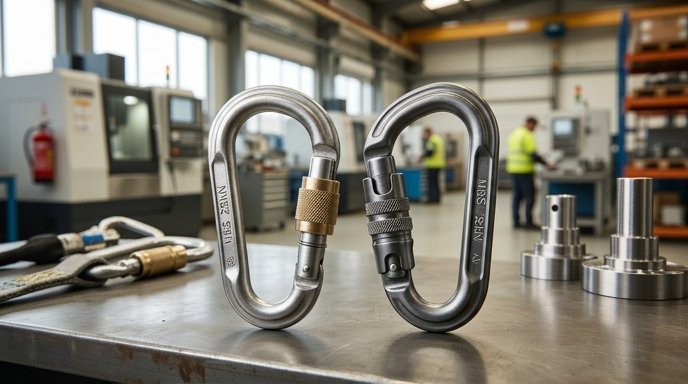
Screw Gate vs Auto-Lock Carabiner: Which Is Safer?
Auto-lock carabiners are statistically safer against user error. Screw gates can be equally safe when used correctly, and they hold up better in mud, grit, or freezing conditions. The honest answer to “which is safer” depends on the job: belay, anchor, and industrial PPE each pull you toward different mechanisms. 1. The Mechanical Difference That Actually Matters A screw gate is a locking carabiner that needs you to manually rotate a sleeve to secure the gate. An auto-lock uses a spring-loaded mechanism that requires two or three deliberate actions to open. The real distinction is the default state of the sleeve. A screw gate sits unlocked until you intervene. An auto-lock snaps to locked the instant the gate closes. That matters because carabiners lose roughly two-thirds of their strength when the gate is open. The Petzl Am’D is rated to 27 kN along its major axis closed, and drops to 8 kN with the gate open. The Black Diamond RockLock Screwgate goes from 24 kN closed to 8 kN open. Same story across almost every locker on the market. Auto-locks come in two flavors: Two-action (twist-lock): twist the sleeve, pull the gate. Three-action (triple-lock): push or pull the sleeve, then